
Blog

Subscribe to receive our free Beginner's Guide to Psychedelic Integration.
How to Eat Before a Psychedelic Experience: A Practical Guide
What you eat in the hours and days before a psychedelic experience can meaningfully affect how it unfolds — and most of the guidance circulating online is incomplete or inaccurate. A therapist's practical guide to what helps, what doesn't, and why the body's preparation is part of the work itself.
Most of the writing about preparing for a psychedelic experience focuses on mindset and intention. Both matter. But there's a more practical layer that often gets overlooked, and it can meaningfully affect how the experience itself unfolds.
What you eat — and what you don't eat — in the hours and days before a journey shapes your body's response in ways that can either support the experience or quietly create resistance to it. For many people, this is the difference between a session that flows and a session that's interrupted by nausea, discomfort, or digestive distress.
I want to walk through what's actually useful here, because the information that circulates in psychedelic communities ranges from solid to misguided, and the people preparing for an experience deserve clear, grounded guidance. This applies whether you're preparing for a legal ketamine session, anticipating future legal psilocybin therapy, or working with another medicine. The body's needs are similar across most psychedelic experiences.
Why Food Affects the Experience
Psilocybin — and several other classical psychedelics — works by interacting with the brain's serotonin system. Specifically, it binds to a subtype of serotonin receptor called the 5-HT2A receptor, which is concentrated in the brain but also present in significant numbers throughout the digestive tract.
This is why nausea is one of the most common physical effects of psilocybin. The same receptor activation that produces the psychological experience also stimulates the gut. For some people, this is mild — a slight queasiness in the first thirty to ninety minutes. For others, it can be more intense, occasionally including vomiting, particularly during the onset.
The good news is that thoughtful preparation reduces this significantly. Most of the discomfort isn't about the medicine itself — it's about how the medicine interacts with what's already in your digestive system. Working with your body in advance gives the experience a smoother foundation.
In the Days Leading Up
In the three to five days before a session, the goal is to give your body the conditions for clarity and ease.
Eat clean, whole foods. Vegetables, fruits, whole grains, simple protein sources. The kind of meals you'd choose if you were preparing for a physical event you wanted to feel good for.
Stay well hydrated. Adequate water in the days before makes a real difference. Many people are quietly dehydrated even when they think they aren't.
Reduce caffeine and sugar. Both can leave the nervous system more activated, which doesn't pair well with the openness a psychedelic experience asks for. Slowly tapering caffeine in the days before, rather than stopping abruptly, reduces the risk of caffeine-withdrawal headaches during the session.
Move your body gently. Light exercise, walks, yoga. Nothing exhausting. The goal is circulation and presence, not depletion.
Avoid heavy or hard-to-digest foods in the 24 hours before. Red meat, fried foods, very rich meals. These take longer to digest and can leave your gut still working when the medicine begins.
Avoid alcohol for at least 24 hours before, ideally longer. Alcohol affects the nervous system in ways that interact unpredictably with psychedelics, and the rebound effects can carry into the next day.
Talk to a knowledgeable provider about any medications you take. Some medications — particularly SSRIs and certain mood stabilizers — significantly alter how psychedelics work and may need to be adjusted with medical supervision. This is not a DIY question. If you're considering any psychedelic experience, the medication review is essential, and it's separate from anything you should adjust on your own.
The Day of the Experience
On the day itself, the principle is simple: less is more.
Eat lightly, well in advance. A small, easily digested meal three to four hours before the session is usually ideal. Some clinical protocols recommend fasting for four to six hours before psilocybin specifically, because food in the stomach can slow absorption and intensify nausea. Many practitioners recommend a light breakfast if your session is in the morning, or a small lunch if your session is in the afternoon — eaten early enough to be digested before things begin.
Don't fast completely, unless your provider specifically recommends it. Going into a psychedelic experience entirely empty can produce its own discomfort — blood sugar drops, weakness, light-headedness. The goal is a digestive system that's mostly settled, not entirely empty.
Stay hydrated, but don't overdo water immediately before. A full bladder during a multi-hour experience is its own challenge.
Foods That Tend to Help
Certain foods are reliably easier on the system and can support a smoother experience.
Potatoes
A surprisingly good choice in the hours before a session. Boiled, baked, or mashed (without heavy cream or butter) — they're gentle, filling enough to prevent blood sugar drops, easy to digest, and unlikely to leave anything still working in your stomach when the medicine begins. They're also bland enough that they don't compete with the sensory experience.
Plain starches
White rice. Simple pasta. Plain bread or toast. These are easy to digest, low in fiber that might cause distress, and stabilizing for the stomach.
Bananas
Soft, easily digested, and gentle on the stomach. They also provide some potassium and steady carbohydrate energy.
Ginger
If you're prone to nausea, ginger is genuinely helpful. Fresh ginger tea sipped slowly in the hour before, or ginger candies during the early part of the experience, can reduce the receptor-mediated nausea many people feel at onset. The research on ginger for nausea — across pregnancy, chemotherapy, and motion sickness — is solid, and the same mechanism appears to help with psychedelic-related queasiness.
Herbal teas
Peppermint and chamomile in particular. Both are settling for the digestive system and have a long history of use for nausea. Some people find a small cup of chamomile useful both before the session and during the early phase.
Light broths
If a solid meal feels like too much, a clear vegetable or bone broth can provide some nourishment without burdening digestion.
Foods to Avoid on the Day
Some foods reliably make psychedelic experiences harder.
Meat and fish. Heavy, slow to digest, and often leave the gut still working when the medicine arrives. Some experienced practitioners recommend avoiding meat entirely for 12 to 24 hours before.
Spicy foods. They activate the gut directly, which is exactly the system you want to keep quiet.
Greasy or fried foods. Slow digestion, often produce nausea even on ordinary days.
Very sugary foods. Blood sugar spikes and crashes can amplify the disorientation of the early experience. Avoid candy, pastries, sweetened drinks.
Strong-smelling foods. Garlic, onions, anything you'd notice across a room. Smells get amplified during the experience, and the lingering taste or smell of strong foods can become unpleasantly prominent.
Aged cheeses, cured meats, fermented foods. These contain tyramine, which can interact unpredictably with serotonergic compounds. This matters especially for anyone working with substances that affect MAO (like ayahuasca), but it's a sensible precaution for any psychedelic experience.
Alcohol. Already noted above, but worth repeating. Even small amounts the night before can affect how the experience unfolds.
A Small Practical Note
This one comes up rarely in writing about psychedelic preparation, but it's worth knowing: brush your teeth before the session.
An unpleasant taste in your mouth can subtly amplify nausea, and during a long session, you may not realize how much a stale taste is bothering you. Starting clean helps. Some practitioners keep mints or sugar-free gum nearby for the same reason.
During the Experience
Most people don't want food during a psychedelic experience itself. The digestive system has effectively quieted, and the focus is inward.
A few exceptions:
Sips of water. Always available. Take them slowly.
Ginger tea or candies if nausea arises.
Light snacks toward the end. As the experience begins to soften and you're moving back toward ordinary consciousness, a piece of fruit, some crackers, or a small bowl of soup can be grounding. The body often welcomes gentle nourishment as it returns.
What Eating Has to Do With the Larger Experience
There's a deeper point underneath all of this practical guidance, and I want to name it briefly.
How you treat your body in the hours and days before a psychedelic experience is itself part of the experience. The care you take in choosing what to eat, the attention to hydration, the small acts of preparation — these are not separate from the medicine. They are an early form of the intention you're bringing to the work.
People who arrive having paid attention to their bodies often report something subtle but real: a sense of having met themselves halfway. The medicine doesn't have to fight uphill against indigestion, dehydration, or the residue of yesterday's meal. The system is already softening. The body has been told something important is coming, and I am preparing.
This kind of care is one of the small ways the experience becomes more than just an event. It becomes the natural conclusion of a process you've already begun.
A Closing Note
None of this is rigid prescription. People vary. Some have sensitive digestive systems and need more careful preparation; others can eat normally and feel fine. The guidelines here are a starting point — what tends to work for most people, drawn from clinical experience and the practical wisdom of practitioners working in this field.
If you're preparing for a psychedelic experience in a legal therapeutic setting, your provider should give you specific guidance, and you should follow theirs over anything in a blog post. If you're preparing for an experience in another context, this information may be useful background.
The body is your partner in this work. Treating it with care is part of the work itself.

Psilocybin and Compassion: A New Model for Treating Depression
Even profound psilocybin experiences often fail to dislodge the harsh inner voice that drives chronic depression — but a 2022 Frontiers in Psychiatry paper outlines how pairing psilocybin therapy with Compassion Focused Therapy may finally reach this layer. A therapist on why these two approaches complement each other so powerfully, and what it means for the deeper work of transforming the relationship you have with yourself.
When people read about psilocybin therapy in the news, the headlines tend to focus on the dramatic part: the experience itself. The mystical states. The breakthroughs. The clinical trials showing rapid relief from depression after years of other treatments not quite working.
The headlines aren't wrong. The experiences can be that profound. But there's a quieter question, less covered, that's been increasingly important in the research:
What happens after the experience?
For some people, the answer is real and lasting change. For others, the gains fade within weeks or months. They return to the same patterns — the same self-criticism, the same depression, the same harsh inner voice — that the experience seemed to interrupt. And they're often left more demoralized than before, having glimpsed freedom and lost it.
A growing body of clinical thinking suggests this isn't because psilocybin doesn't work. It's because the experience, on its own, doesn't address one of the most stubborn structures in depressive suffering: the relationship a person has with themselves.
A 2022 paper in Frontiers in Psychiatry proposes a specific solution to this gap: pairing psilocybin therapy with Compassion Focused Therapy, or CFT, an approach developed by clinical psychologist Paul Gilbert that targets the harsh inner voice directly. I want to walk through why this combination matters — because for many of the people I see, the inner critic is the part of suffering that survives every other treatment.
Why Psilocybin Opens Something Few Other Tools Can Reach
Psilocybin, the active compound in psychedelic mushrooms, does something to consciousness that most other therapeutic tools don't.
It temporarily disrupts the brain's default mode network — the system responsible for self-referential thought, narrative, and the felt sense of being a separate self. In ordinary consciousness, this system is mostly running in the background, producing the internal commentary that accompanies most of our waking lives. Under psilocybin, this commentary loosens. The grip of habitual self-perception softens. The story you've been telling about who you are can briefly suspend.
What people experience during this opening varies. Some encounter a deep sense of connection — to themselves, to others, to something larger. Some meet old material — grief, fear, suppressed memories — with a kind of openness that ordinary consciousness wouldn't allow. Some have what they describe as mystical or transformative experiences. Some simply find that the relentless self-monitoring quiets for the first time in years.
Clinical research has shown that even a single dose of psilocybin, in a clinical setting with appropriate support, can produce rapid and sustained reductions in depressive symptoms — in some cases lasting a year or longer. For people whose depression has not fully responded to medications and therapy, this is meaningful.
But this is where the gap appears. Because while the experience can open something profound, the question of what happens next — what the person does with the opening — turns out to matter enormously.
What Often Survives the Experience
In my clinical work, and in the research, one of the most persistent observations is this: even powerful psychedelic experiences often fail to dislodge the harsh inner voice.
The person comes back from a profound session with new insight, new openness, a felt sense of having touched something important. And within weeks, the same critical voice that was there before is back — sometimes quieter at first, but slowly reasserting itself. You're falling behind. You're not doing the work right. You should be further along by now. What's wrong with you that you can't make this stick?
This voice is not the depression itself. It's something more specific: the internalized harshness that many people with chronic depression carry as a kind of baseline. Self-criticism. Shame. The conviction that there is something fundamentally wrong with them. The relentless evaluation of every thought, every feeling, every action against an impossibly demanding internal standard.
For many people with depression, this inner critic is the actual engine of their suffering. The depressive symptoms — low mood, withdrawal, hopelessness — are downstream effects of an inner relationship that has been adversarial for years, often decades.
And here's why this matters for psilocybin therapy: opening the system doesn't automatically rewrite the inner relationship. The system can soften, profound material can emerge, and a person can still come back to a self who relates to them harshly. The container of the inner relationship survives even the most dramatic experiences, unless that container is specifically worked with.
This is where CFT enters the picture.
What Compassion Focused Therapy Actually Is
Compassion Focused Therapy, developed by Paul Gilbert at the University of Derby in the early 2000s, was designed specifically for people who struggle with chronic shame and self-criticism. Gilbert noticed that traditional cognitive therapies — which work with the content of thoughts — often fell short for clients whose problem wasn't really what they were thinking but how they were relating to themselves.
You could correct a thought a thousand times. The voice that delivered the correction would still be harsh. The relationship to oneself remained punishing, even as the surface beliefs changed.
CFT's central insight is that human beings have three core emotional regulation systems, evolved for different functions:
The threat system. Activated by danger, criticism, judgment, social rejection. It produces anxiety, fear, anger, vigilance. It motivates self-protection. In small doses, it's lifesaving. Chronically activated, it produces persistent suffering.
The drive system. Activated by goals, achievement, pleasure-seeking. It produces motivation, excitement, ambition. In modern culture, this system is often hyperdeveloped — people live in chronic striving toward the next achievement.
The soothing system. Activated by safety, connection, care. It produces calm, contentment, the felt sense of being held and accepted. It's regulated by oxytocin and other affiliative neurochemistry. This is the system that allows the nervous system to actually rest.
In healthy regulation, all three systems are functional and can balance each other. In chronic depression and anxiety, the threat and drive systems are typically overactive, while the soothing system is underdeveloped — sometimes severely.
Many people with depression have spent their entire lives without much soothing system activity at all. They've been driven, vigilant, self-critical — but rarely warm with themselves, rarely held, rarely safe in their own care. The system that should produce internal warmth has, in effect, atrophied from lack of use.
CFT's work is to deliberately develop the soothing system. Through specific practices, exercises, imagery, and reflection, the person learns — often slowly, often awkwardly at first — what it actually feels like to meet their own suffering with warmth instead of judgment.
This is not the same as telling yourself to feel better. It's not affirmations. It's the slow biological development of a regulatory system that has been quietly missing.
Why These Two Approaches Fit Together So Well
The pairing of psilocybin and CFT is more than additive. Each addresses a layer of the problem the other can't reach on its own.
Psilocybin opens the system. It temporarily disrupts the rigid patterns of self-perception and emotional reactivity that depression locks people into. It creates an opening in which new experiences become possible — including, for the first time in some cases, the felt experience of acceptance, connection, or warmth toward oneself.
CFT teaches the person what to do with the opening. Once the system has softened, CFT provides the practices, language, and framework for building a new internal relationship. Not just having a momentary glimpse of self-compassion, but developing it into a stable capacity that survives the closing of the opening.
Without CFT, the psilocybin experience can produce real moments of inner warmth that fade as the harsh voice reasserts itself. Without psilocybin, CFT can be effective but often slow — the harsh voice can be remarkably resistant to gentle approaches that don't include the kind of system disruption psilocybin offers.
Together, the two appear to do something neither does alone: the opening and the inner reshaping happen in coordinated phases that reinforce each other.
What This Looks Like in Practice
The 2022 paper outlines a structured protocol that pairs psilocybin sessions with CFT-based preparation and integration.
In the preparation phase, the patient learns about the "tricky brain" — Gilbert's accessible framing of the fact that our brains evolved capacities (self-criticism, threat detection, social comparison) that were useful in ancestral environments but produce significant suffering in modern life. The patient also learns basic compassion practices — soothing breathwork, compassionate imagery, ways of speaking to themselves that they may have never tried before.
This preparation does important work. It gives the patient a framework for understanding what their mind is doing. It introduces practices that may feel foreign or even uncomfortable at first. It begins building the soothing system in advance of the psilocybin session, so there's something to come back to afterward.
The psilocybin session itself is largely non-directive. The patient is supported but not steered. The work of meeting whatever arises is theirs. Often, in this state, the warmth they've been practicing with effort can become available with less resistance — the inner critic loosens enough that compassion can briefly take its place.
The integration phase is where CFT becomes essential. The opening from the session is real but temporary. Whatever was glimpsed has to be deliberately built into ordinary life through practice. Compassionate self-reflection. Imagery work that develops the soothing system. Recognizing the parts of the self that have been suppressed or rejected. Speaking to oneself in the voice one would speak to a loved one.
This work is slow. It's also where lasting change actually happens.
The Deeper Shift
What this model points toward is something I find clinically and personally important.
For a long time, mental health treatment has focused on symptom reduction. The depression scores go down. The anxiety subscale improves. The medications produce measurable changes.
What this approach suggests is something different. It's not really about reducing symptoms. It's about transforming the relationship a person has with their own inner life.
The depression may lift. The anxiety may quiet. But the deeper change — the one that holds — is in how the person meets themselves. Whether their default response to their own suffering is judgment or care. Whether they treat themselves as adversaries or as someone worthy of warmth.
Many people have never had this experience of themselves. They've been their own harshest critic for so long they don't even recognize the harshness as something separate from who they are. The combination of psilocybin's opening and CFT's compassionate scaffolding can, for some, be the first introduction to what an alternative actually feels like.
What's Still Uncertain
This approach is still emerging. The 2022 paper is theoretical and clinical rather than the kind of large randomized controlled trial that would establish it as standard practice. There's a great deal we don't yet know:
How many psilocybin sessions optimize outcomes. How much CFT preparation and integration is necessary. Whether other compassion-focused approaches — Internal Family Systems, mindful self-compassion, ACT-based approaches — work equally well, or whether something specific about CFT fits psilocybin particularly. How outcomes compare to other psychedelic-assisted therapy models.
These are real questions. The clinical trials currently underway in the U.S. and Europe will help answer some of them in the next few years. As psilocybin therapy moves toward potential legalization in various jurisdictions, the question of what to pair it with will become increasingly important.
What seems clear from the existing research and clinical observation is that the answer isn't nothing. The medicine alone, without thoughtful psychological support around it, produces less durable change than the medicine combined with skilled integration. The question is what kind of psychological support best leverages what the medicine offers.
For people whose suffering is significantly shaped by harsh self-criticism — which describes a great many people with chronic depression — CFT or something like it appears to be a particularly powerful match.
A Closing Thought
What I find most hopeful about this model is its underlying premise: that suffering is not a fixed feature of who you are, and that the relationship you have with yourself can change.
For people who have spent decades inside a punishing inner relationship — who have come to assume that this is just how they are — the possibility of relating to themselves differently can be one of the most meaningful discoveries of their lives. Psilocybin may help open the door. The slow, real work of building self-compassion is what makes the new room livable.
If you've found that the standard approaches haven't fully reached the harsh inner voice that drives your suffering, and you're curious about what integrative work could look like for you, you're welcome to book a consultation. Whether or not you ever work with psilocybin or any other medicine, the work of changing your inner relationship is possible — and it can begin now.
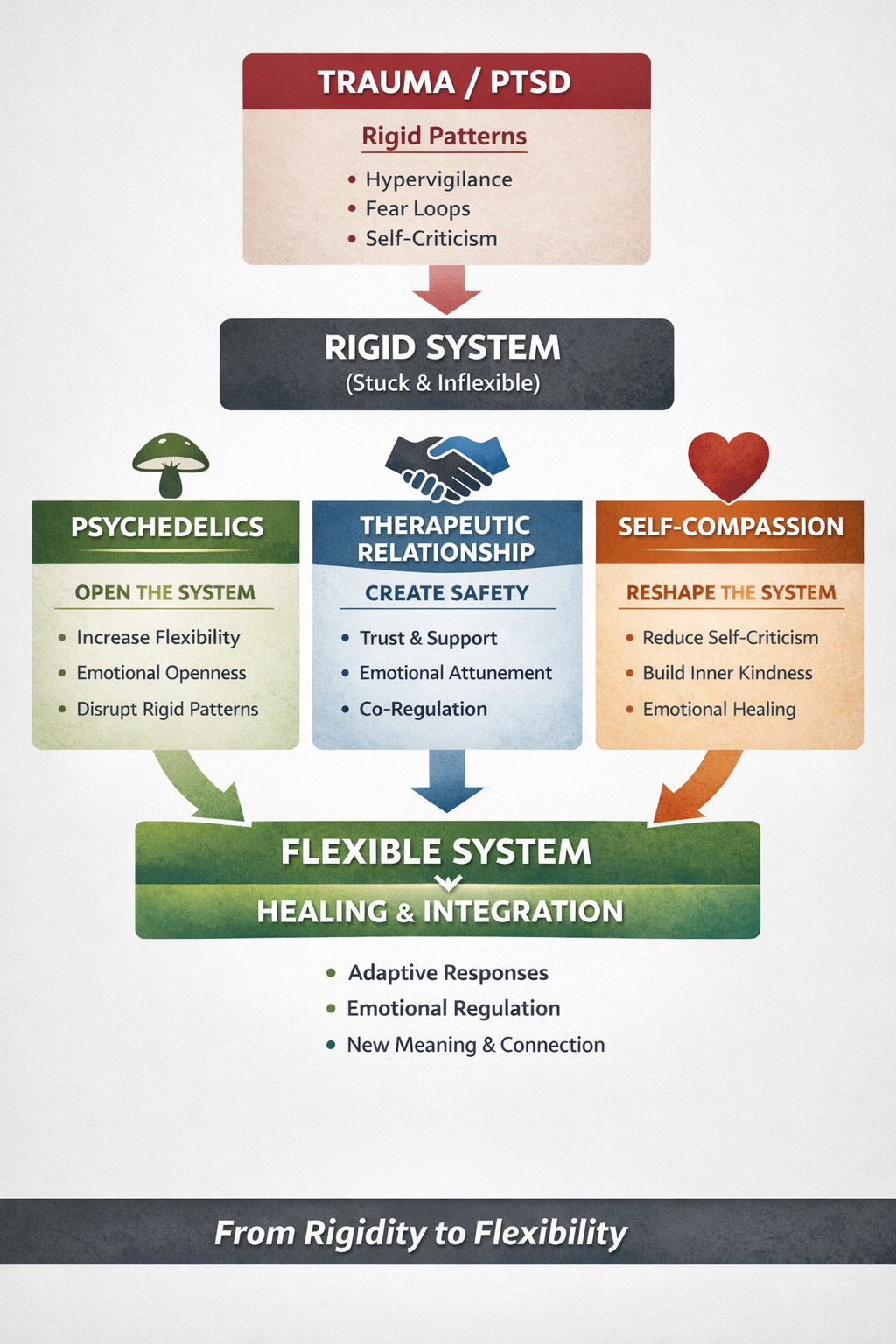
How Healing Actually Works: Psychedelics, Compassion, and the Power of Relationship
A 2023 study followed 86 Special Operations Forces veterans through a psychedelic treatment program and found significant reductions in PTSD and alcohol misuse — but the deeper finding wasn't really about the medicines. A therapist on what the veterans' experience reveals about how healing actually works, and why no single intervention is ever enough on its own.
There's a particular kind of suffering that doesn't always respond to the treatments we have.
The combat veteran with PTSD who has tried multiple medications, several courses of therapy, and is still waking up at three in the morning unable to settle. The first responder whose nervous system hasn't been able to stand down for years. The person whose trauma is so old and so layered that ordinary treatment can reach part of it, but not the part that's actually keeping them locked in.
These are the people who teach us, when we listen, that healing is more complicated than our standard models suggest. And in 2023, a study published in Military Psychology added something important to what we know about what's possible for people in this kind of suffering.
The study followed 86 U.S. Special Operations Forces veterans — Navy SEALs, Special Forces, Special Operators — who traveled to Mexico for a single psychedelic treatment program involving two compounds: ibogaine and 5-MeO-DMT. These were not casually exposed individuals. They were combat veterans with significant trauma exposure, many with co-occurring alcohol misuse and post-traumatic stress symptoms.
What the researchers found was striking. One month after treatment, participants reported substantial reductions in PTSD symptoms, depression, anxiety, and problematic alcohol use. Many described the experience as among the most meaningful of their lives.
But the deeper finding — the one I want to spend time with — wasn't really about the medicines. It was about what the medicines opened, and what made that opening usable.
What This Study Actually Showed
The combination of ibogaine and 5-MeO-DMT, paired with preparation and integration support, appeared to produce something traditional treatment for these veterans had often not been able to reach.
Why this matters: veterans with combat-related PTSD are notoriously difficult to treat. Standard protocols — cognitive processing therapy, prolonged exposure, SSRIs — help some, but a significant percentage of veterans remain symptomatic after years of treatment. For this population, the combination of psychedelics and structured therapeutic support seemed to reach something the other tools couldn't.
The researchers were careful not to overstate what they had found. This was an observational study, not a randomized controlled trial. The veterans self-selected into treatment, which introduces bias. The follow-up period was short. But within those limits, the findings pointed toward something worth taking seriously: a different model of healing might be possible for the people standard treatment has been failing.
That different model is what I want to talk about — because it's not just about veterans, and it's not just about ibogaine. It's about what the research is increasingly suggesting about how change actually happens in people whose suffering has stayed stuck.
Trauma as a System That Stopped Updating
To understand why this kind of treatment may work where others haven't, it helps to look at what trauma actually is at the system level.
Trauma is not, fundamentally, an event. It's a pattern that won't update. Something happens — sometimes once, sometimes many times — that the nervous system can't fully process in the moment. To survive, the system adapts. It learns vigilance. It learns to brace. It learns to suppress what can't be felt. It learns to expect the next threat.
These adaptations are intelligent. They saved your life, or made an unbearable situation bearable. The problem is that they don't shut off. The nervous system that learned to scan for danger in 2007 is still scanning in 2026. The body that braced against grief in childhood is still braced today. The system has become rigid — locked into a configuration that no longer matches the world the person is actually in.
The challenge of healing trauma, then, isn't really about removing the memory or correcting the thought. It's about helping a system that has become rigid become flexible again.
This is where psychedelics enter the picture. Not as cures. As something more interesting: as catalysts that can temporarily soften the structures the trauma is held in, creating an opening for the system to reorganize.
What Psychedelics Actually Do at the System Level
The neuroscience suggests that psychedelic medicines like psilocybin, ibogaine, MDMA, and 5-MeO-DMT share a common effect, though they work through different mechanisms: they temporarily increase the brain's flexibility, sometimes called neural plasticity or cognitive flexibility.
What this looks like, in lived terms:
Rigid thought patterns soften. Defenses ease. The grip of old narratives loosens. Material that has been carefully kept at a distance can come into view. Emotions that have been frozen can move. Memories can be revisited with something other than the original terror.
This is the opening. And for many people, including the veterans in the study, the opening itself is meaningful. The sense of being released, even briefly, from a pattern that has felt like a permanent feature of one's life can be one of the most significant experiences a person ever has.
But here's the part the research keeps confirming, and the part most marketing of these medicines glosses over:
The opening, by itself, is not the healing.
If the system opens and there is no structure around it, no relationship to hold what surfaces, no support to integrate what emerges — the opening tends to close again. The pattern reasserts itself. The relief proves temporary. People often describe this as the worst version: glimpsing freedom and then losing it.
What turns the opening into actual healing is what surrounds it.
What the Veterans' Experience Reveals
The Special Operations Forces veterans in the Armstrong study didn't just take ibogaine and 5-MeO-DMT and go home. They were in a structured program with preparation, supervision, and integration support. The researchers identified specific elements of the experience that participants associated with their improvement.
Three things kept showing up:
The experience itself. The altered state, the encounters with memories and emotions and material that had been stored away, the felt sense of being released from rigid patterns. The medicine produced something that traditional therapy hadn't been able to deliver: a direct, embodied experience of being outside the trauma pattern, even temporarily.
The relational container. The veterans were not alone. They were in a setting with people who knew what to do, who had presence and skill, who created the safety required for the opening to be workable rather than overwhelming. The participants consistently named the importance of feeling supported and held.
Integration. What happened after the experience mattered as much as what happened during it. The work of metabolizing what came up, of bringing insights into ordinary life, of letting the system reorganize around what had been revealed.
The medicines were one of three legs of the stool. Without the other two — the relationship and the integration — the medicines alone would not have produced what they produced.
The Inner Layer: Self-Compassion
There's a fourth piece that the research, and my clinical experience, keep pointing toward.
It's not enough to soften the trauma pattern, provide a safe container, and integrate the experience. For lasting change, the internal relationship — the one between the person and their own suffering — has to shift too.
For people with long trauma histories, the inner relationship is often punishing. Harsh self-criticism. Persistent shame. The conviction that something is wrong with them at a fundamental level. These patterns survive even profound psychedelic experiences. They reassert themselves in the weeks and months after, often quietly undoing what the experience opened.
Self-compassion, by contrast, creates a different kind of inner ground. Instead of meeting the difficult material with judgment, the person learns to meet it with care. The research is now clear that this isn't soft thinking — it's a measurable shift in nervous system regulation, in emotional resilience, and in capacity to integrate difficult experience. It changes how pain is held, even when pain remains.
Many of the veterans in studies like this one have described, in their own words, something like this: they discovered they could meet their own history with something other than the harshness they had been carrying for years. That shift in inner relationship, more than any single insight, was what allowed the changes to take root.
A Unified Picture
Looking across the trauma research, the psychedelic research, the work on therapeutic relationship, and the work on self-compassion, a unified picture emerges that I find clinically and personally meaningful.
Healing isn't really one thing. It's the interaction of several things, all of which have to be present for real change to happen:
Opening — through medicine, through movement, through experience, through any of the practices that temporarily loosen the structures that suffering has been held in.
Holding — through relationships of real safety and skill, both with practitioners and with people who can witness what's emerging without flinching.
Integration — through the slow work of letting what was opened become woven into ordinary life, the patterns of behavior, the body, the choices, the way time gets spent.
Inner softening — through the slow change in how a person relates to themselves, from criticism toward care.
When all four are present, lasting change becomes possible. When any of them is missing, the work tends to stall.
What This Means Beyond Veterans
The Armstrong study focused on veterans, but the model it points to applies more broadly. Anyone whose suffering has stayed stuck despite their best efforts — through trauma, through chronic depression, through anxiety that hasn't responded to standard treatment, through addiction patterns that won't release — may benefit from understanding healing this way.
Not as a single intervention to find.
But as a system of openings, holdings, integrations, and inner shifts, all of which have to come into alignment.
Psilocybin therapy, when it becomes legally available, will offer one path. Ketamine-assisted psychotherapy is already offering another. Plant medicines in legal jurisdictions offer others. Even without medicines, the same model applies: openings can come from breathwork, from somatic practice, from deep contemplative work, from moments of grace. What matters is that the rest of the structure be in place to hold and integrate what opens.
A Closing Reflection
What I find most moving about the Armstrong study, and about the broader research it joins, is what it implies about the nature of suffering.
The suffering of these veterans was not a personal failing. It was not a moral weakness. It was a nervous system that had organized itself around survival under conditions most of us will never face — and then could not, on its own, find its way back to flexibility.
What helped them wasn't a single intervention. It was a coordinated process: the medicine that softened the structure, the relationship that held the opening, the integration that let the change take root, the slow shift in how they met themselves afterward.
This is, I believe, how healing actually works. For veterans, for survivors of childhood trauma, for anyone whose suffering has stayed locked in a system that stopped updating.
Healing happens when rigid systems become flexible again — through openness, safety, integration, and the slow turning of compassion inward. None of these alone is enough. Together, they make change possible that none of them could produce on its own.
If you're sitting with what feels like a pattern that won't update, and you'd like to explore what this kind of integrative work could look like for you, you're welcome to book a consultation.