
Blog

Subscribe to receive our free Beginner's Guide to Psychedelic Integration.
Set, Setting, and the One Variable Nobody Measures
Everyone in this field talks about set and setting. Almost nobody talks about the third variable underneath both: your biochemistry on the day, which for half the population isn't fixed. A therapist on a new review of hormones and psychedelics, the trials that excluded women for decades, and why the honest answer right now is that we don't know yet.
Ask anyone in this field what determines a psychedelic experience and you'll hear the same two words. Set and setting. Your mindset going in, and the environment you're in. It's a genuinely good insight, and it's why preparation and integration exist as disciplines at all.
But there's a third thing, and it sits underneath both of the others. Your internal biochemistry on the day. For roughly half the population, that biochemistry is not a fixed baseline. It moves on a monthly cycle, shifts across the reproductive lifespan, and changes again with contraceptives or hormone therapy.
A narrative review published in Molecular Psychiatry in August 2026 by Kim Kuypers and colleagues at Maastricht University pulls together what's known. The short answer is that the mechanisms are plausible and mostly unmeasured. That gap is worth understanding, because it shapes what we can and can't say about psychedelics and women's mental health right now.
What we do know
Start with the part that isn't in dispute.
Women carry a disproportionate share of depression, anxiety, PTSD, and eating disorders. And for many women, the severity of those symptoms is not stable across the month. Systematic reviews have documented perimenstrual worsening in anxiety disorders, PTSD, and OCD. Bipolar symptoms often intensify premenstrually. Psychotic symptoms show a perimenstrual increase that appears to track the drop in estradiol. Binge eating rises in the mid-to-late luteal phase. Premenstrual dysphoric disorder is the clearest case of all, with symptoms arriving reliably as progesterone and estradiol fall.
This isn't controversial. It's decades of clinical observation with the research to back it.
Second piece: sex hormones change how the body handles drugs. Progesterone slows gastrointestinal transit, which affects how quickly something taken by mouth gets absorbed. Estradiol and progesterone both influence liver enzymes, including CYP3A4 and CYP2D6, which happen to be central to how the body processes LSD and psilocin. Body composition and fluid balance shift across the cycle, changing how a compound distributes through tissue.
None of this is speculative pharmacology. It's the same reason antidepressant response and side effect profiles can vary by cycle phase.
Third piece, and this is the one that should get attention. Classic psychedelics work primarily through the serotonin 2A receptor. Estradiol appears to regulate that receptor. PET imaging studies in postmenopausal women found that estrogen therapy increased cortical 5-HT2A binding, including in prefrontal regions. Women who have gone through menopause without hormone therapy show lower receptor availability than cycling women.
Put plainly: the receptor these substances act on is not a fixed quantity. It varies with hormonal state.
What we don't know
Here's where it gets thin.
No human study has directly measured how menstrual cycle phase affects psychedelic pharmacokinetics. Not one. The review says so explicitly: direct human data for psychedelics remain absent. Almost everything connecting hormonal state to psychedelic response is inference, drawn from general pharmacological principles and from receptor studies conducted for other reasons.
It's also worth knowing what kind of paper this is. A narrative review synthesizes existing literature and builds an argument. It isn't a systematic review with pooled data, and it isn't new evidence. The authors are admirably clear about this and flag the limitation repeatedly. Some of the receptor work comes from platelet binding assays, and whether platelet findings translate to the brain is an open question. Where clinical evidence was missing entirely, they had to reach for preclinical work.
The review does suggest that subjective and adverse effects might be most pronounced during the early-to-mid follicular and early luteal phases. That is a hypothesis. It is not a finding, and it is emphatically not a dosing schedule.
Why the gap exists
This is the part I find hardest to sit with.
A scoping review published in 2025 looked at psychedelic research for substance use disorders and found female participation in clinical trials running at 19%, which is 372 participants out of 1,922. Seventy percent of the studies didn't do anything with sex beyond reporting how many women were enrolled. None treated sex or gender as a central analytic focus. Historically it's worse: 13.3% female participation before 1990, improving only to 27% after.
The reasoning behind excluding women from trials was always circular. Hormonal fluctuation makes results messier, so exclude the people who fluctuate, so the results stay clean, so we never learn what the fluctuation does.
And there's a detail I can't stop thinking about. Researchers have pointed out that when a trial protocol schedules dosing sessions four weeks apart, each participant ends up being dosed at roughly the same point in her cycle every single time. Whatever effect cycle phase has, it gets baked into her results consistently and invisibly. A structural blind spot hiding inside a scheduling convention.
This is the same class of problem that surfaced in the FDA's rejection of MDMA-assisted therapy. Design choices made for convenience or cleanliness turn out to determine what the trial can and cannot detect.
The postpartum caution
One finding deserves separate mention because it runs against the optimistic grain, and because it's stronger than a passing reference would suggest.
There's real interest in psychedelics for postpartum depression, and the reasoning is sound on paper. A 2025 study in Nature Communications from David Olson and Danielle Stolzenberg's groups at UC Davis tested it in a mouse model of peripartum mood disorder. Psilocybin did not ameliorate any of the stress-related maternal behaviors. Weeks after a single dose, the treated mothers were more anxious than untreated ones, and this held regardless of whether they'd been stressed at all. The researchers described them as dramatically impaired and said they were shocked by it.
The comparison group is what makes this hard to dismiss. Virgin female mice given the same single dose showed the expected anxiolytic effect. Reproductive status was the variable that flipped the direction of the result.
Offspring exposed to psilocin through breastmilk showed anhedonia in adulthood.
That's animal work, with all the translation caveats, and it should be held as animal work. But it's the opposite of what the enthusiasm predicted. And Phase 2 trials are currently recruiting postpartum parents for a psilocybin analogue, which makes this a live question rather than a theoretical one.
What this actually means
I want to be careful here, because there's an obvious wrong conclusion available.
The wrong conclusion is that women should now be timing sessions to their cycle. The evidence does not support that. Nobody has measured it. Anyone offering cycle-timing protocols right now is extrapolating well past what exists.
The right conclusion is more modest and, I think, more useful. If you're a woman who has had psychedelic experiences that varied a lot in intensity for reasons you couldn't explain, there may be a real biological contributor, and the inconsistency was not a failure of your preparation. And if you're working with a practitioner, hormonal context belongs in the intake conversation the same way sleep and medication do.
A few things worth knowing about yourself or asking a client about:
Cycle phase, if applicable, and whether symptoms follow a predictable monthly pattern. Contraceptive use, since synthetic hormones appear to reshape receptor dynamics rather than simply stabilizing them. Menopausal status and whether hormone therapy is in the picture, along with the formulation and route, because transdermal and oral estradiol behave differently. And SSRI status, which matters most of all, since SSRIs are first-line for PMDD and there's actual human data showing they can blunt the acute effects of psilocybin.
That last one is the only item on the list with solid human evidence behind it. Everything else is a question to hold, not a variable to optimize.
A note on scope
This research concerns classic serotonergic psychedelics taken orally: psilocybin, LSD, ayahuasca. Ketamine acts through a different receptor system, so the 5-HT2A mechanism at the center of this work doesn't transfer to ketamine-assisted therapy. The general pharmacokinetic points aren't receptor-specific and could in principle apply, but nobody has studied that either. The broader point about women being understudied still stands.
Sitting with not knowing
The honest position is that we're at the beginning. We know women's neurochemistry moves in ways that should plausibly change how these substances work. We know the research hasn't looked. We don't know what we'd find if it did.
That's starting to change, at least. A trial protocol published in August 2026 sets out to test menstrual cycle effects and tolerability of low-dose psilocybin in healthy menstruating people, which is close to the study this whole literature has been missing. One protocol isn't a body of evidence. But it means the question is finally being asked directly rather than inferred around.
Until then, the unsatisfying place to land is where the evidence actually is. There's a version of this field that fills uncertainty with confident protocols, and a version that names the gap and keeps working. The second one is slower. It's also the one that ends up knowing something.
The Self Was Never Solid: What Buddhism Knew and Neuroscience Is Catching Up To
Neuroscience now says the self is a process your brain runs rather than a thing you have. Buddhism said something close to that twenty-five centuries ago, by a completely different route. A therapist on where the two converge, where they don't, and why the argument among Buddhist teachers about psychedelics is worth taking seriously rather than resolving.
There's a sentence in contemporary neuroscience that would not have surprised a meditation teacher from twenty-five centuries ago.
The sentence is that the self is not a thing you have. It's a process your brain is running.
I wrote about this recently in the context of Anil Seth's work on consciousness as controlled hallucination. Your brain predicts the world and uses your senses to correct the predictions. The same is true of your sense of being someone. That felt continuity, the person you take yourself to be, is generated moment to moment rather than stored somewhere.
Buddhism got there first, by a considerable margin, and by a completely different route.
The parallel, stated carefully
The Buddhist teaching closest to this is anattā, usually translated as non-self.
It isn't the claim that you don't exist. It's the claim that when you look closely for a stable, unchanging self behind your experience, you don't find one. You find sensations, feelings, perceptions, impulses, and awareness, all of them in motion. The self shows up as a pattern in that motion rather than as the thing having it.
That's remarkably close to what predictive processing describes. Not identical, and I want to be careful here. Buddhist teaching arrived through introspection and centuries of argument. Seth arrives through cognitive neuroscience. They're answering different questions and they don't map onto each other cleanly.
But the shape is the same. There is no small person inside your head watching the show. There's a process that generates the impression of one.
Both get misread the same way
Here's what I find more interesting than the resemblance itself.
Both frameworks spend enormous energy defending against the same misunderstanding.
Seth has to keep clarifying that calling perception a hallucination doesn't mean the world isn't real. Controlled hallucination is a claim about how experience is produced, not about whether anything exists.
Buddhist teachers have to keep clarifying that non-self doesn't mean nothing matters. Nihilism is explicitly rejected in the tradition. It's treated as an error, not a conclusion.
This isn't only a resemblance people notice in passing. Researchers have built formal accounts of it, which I've written about separately in When the Mind Stops Predicting.
Where psychedelics come in
The most striking study combined both directly.
A team at the University of Zurich, led by Lukasz Smigielski under Franz Vollenweider, ran a randomized, double-blind, placebo-controlled trial inside an actual meditation retreat. Thirty-nine experienced meditators spent five days in silence following a structured Zen discipline called sesshin, a fifteen-hour daily schedule of sitting meditation, walking meditation, mindful work, and recitation. On the fourth morning, half of them received psilocybin and half received placebo.
The psilocybin group went deeper into meditation and reported self-dissolution experiences that were overwhelmingly positive rather than frightening, with no accompanying spike in anxiety. Four months later, they showed greater gains in how they were functioning socially and psychologically than the placebo group did. Those gains were confirmed by people who knew them, not just self-reported. And the size of the gain tracked how intensely the self had dissolved during the session.
So this is not hypothetical. Psilocybin has been formally studied inside a Zen retreat, with the retreat structure fully intact.
The part that surprised me
Here's where my own assumption turned out to be wrong.
I had a vague sense that contemplative practice aims at transcending the body. Leaving it behind. Getting out.
That isn't what the traditions do. In Theravāda practice, the unusual states that arise along the way, including lights, rapture, and dissociative phenomena, have a classical name: vipassanā-upakkilesa, the corruptions of insight. They are explicitly things to notice and not to chase. Zen has a parallel category in makyō. Attachment to remarkable states is treated as a trap, not a destination.
What the practices actually instruct is attention to breath, posture, and bodily sensation. The method is going further in.
And this is exactly where Seth's account points. He emphasizes that the sense of being a self is grounded in interoception, the brain's ongoing perception of signals from inside the body. Your feeling of existing is built from your body's continuous modeling of its own condition.
Put those together and something clarifies. If the self is constructed largely out of the body's self-monitoring, then the way to loosen the construction is to go toward that monitoring rather than away from it. You don't dissolve the self by escaping the body. You dissolve it by paying such close attention to the body that the construction becomes visible as construction.
That's a strange and satisfying convergence. Two thousand five hundred years of practice arriving at a method that predictive processing would recommend.
The disagreement is real
I'd be misrepresenting the situation if I made this sound harmonious. Buddhists are actively arguing about this, and the argument is substantive.
Some teachers have moved toward integration. Writing in Lion's Roar, Matteo Pistono reported from the first Psychedelic Buddhism conference, held in February 2025 at The New School in New York and drawing more than six hundred participants online and in person. Teachers from Theravada, Insight, Zen, and Vajrayana lineages spoke about ethics, risk, legality, and the difficulties of integrating psychedelics into practice. Stephen Batchelor, whose talk was titled "Psychedelics and the Middle Way," described LSD bringing him to a profound state of non-reactive awareness, which he identified as the core of dharma practice.
Others object, and not casually. The fifth precept calls for abstaining from intoxicants, and many teachers remain committed to it. In a 2018 piece for Tricycle, Jesse Maceo Vega-Frey, resident teacher at Vipassana Hawai'i, argued that practitioners get attached to marvelous states while calling it spiritual exploration. His formulation is worth quoting directly. Wanting things to be other than they are is the heart of our imprisonment, he told the magazine, and changing the colors, textures, and flavors of the prison doesn't lead us to freedom.
I think that objection is worth sitting with rather than answering. It names a real failure mode. A powerful state is not the same as a changed life, and the gap between them is where most of the actual work lives. That's the same gap that shows up in psychedelic therapy for depression, where the opening is the easy part and what follows is not.
The same Tricycle piece notes something else worth knowing. Many of the Americans who converted to Buddhism in its early decades here arrived by way of psychedelics in the first place. Whatever anyone concludes about the precept, that history is already in the tradition's American bloodstream.
What I take from it
Not that science has validated Buddhism. That framing flatters both and clarifies neither, and philosophers have pushed back on it hard. Evan Thompson's Why I Am Not a Buddhist is the serious version of that critique if you want to read it. Chris Letheby's work is worth reading alongside it, since he asks a closely related question about what psychedelic experiences can actually establish.
What I take is narrower and more useful.
Two traditions with nothing in common methodologically arrived at the same description of the self. Both say it's constructed. Both say the construction can be seen. Both say seeing it changes something. And both, when you look at what they actually recommend, point you toward your body rather than away from it.
For anyone carrying a version of themselves that has felt permanent for a very long time, that convergence is worth knowing about. The permanence was always the illusion. Not the self, and not the suffering, both of which are real enough. Just the sense that either one is fixed.
The work of integration, in any tradition, is learning to live from that knowledge rather than merely having had a glimpse of it.
If You're on an Antidepressant and Wondering About Psychedelics
Psychedelic therapy is in the news constantly right now, and people are starting to ask whether they should come off their antidepressant to get ready. That decision belongs with a prescriber. But the timeline is longer than most people assume, and it's worth understanding before you need to.
This question has started coming up in my office, and I don't think that's a coincidence. Psychedelic therapy is in the news constantly right now. The FDA has psilocybin and MDMA applications in front of it. People read the headlines, notice they've been on the same medication for eleven years, and start doing math.
So let me say the most important thing first. Nothing here is an argument for coming off your antidepressant. For a lot of people, that medication is the reason they're functioning, and stopping would be a bad idea. This is also not a decision anyone should make with a therapist, a coach, or a website. It belongs to you and the clinician who prescribed it.
What this article is about is timing and sequence. If psychedelic-assisted therapy is something you might want someday, there are things worth understanding now, because the path from here to there is longer and more involved than most people assume.
What the research actually shows
The evidence for psychedelics in depression has gotten substantially more serious in the last two years.
Psilocybin is furthest along. Compass Pathways has now run two Phase 3 trials in treatment-resistant depression, both hitting their primary endpoint, with six-month durability data reported in July 2026. Worth reading those numbers carefully rather than through the headlines. In the second trial, 39% of people on the active dose reached a clinically meaningful reduction in depression scores at six weeks. That is a real result in a population that has failed multiple treatments. It is not everyone getting better.
MDMA is being studied for PTSD rather than depression. The FDA rejected the first application in 2024. In August 2026, MAPS confirmed reports that Resilient Pharmaceuticals had resubmitted, this time without running a new Phase 3 trial.
5-MeO-DMT is earlier. A Phase 2b trial of an intranasal formulation in treatment-resistant depression met its endpoints, with 193 participants. Phase 3 is being planned. Promising, but a long way from your pharmacy.
Ibogaine is the one I'd be most careful about. The serious research is in traumatic brain injury and opioid use disorder rather than depression, and Texas has now funded a large clinical trial program through UTHealth Houston. Ibogaine also carries a risk of sudden cardiac death that the other compounds in this list do not. It requires cardiac monitoring. It is not in the same safety category as psilocybin, and it shouldn't be discussed as though it is.
Where things actually stand legally
Federally, all of these remain Schedule I. Ketamine is the exception and sits in a different category entirely, which matters later in this article.
Oregon and Colorado have licensed programs where adults can access psilocybin in supervised settings. New Mexico passed the Medical Psilocybin Act in 2025 and is building its program now. Everywhere else, including California, there is no legal supervised access.
The pipeline is moving faster than the law is. That gap is exactly where people get hurt, because when something looks imminent, waiting feels unnecessary.
The interaction question, honestly
Here is where I want to be more careful than most of what you'll read.
You'll hear it stated flatly that combining psychedelics with an SSRI risks serotonin syndrome and can kill you. You'll also hear the opposite, that this is overblown. The truth is in between, and it depends on which drug you're asking about.
For ayahuasca, the concern is real and well established, because ayahuasca contains monoamine oxidase inhibitors. That combination is genuinely dangerous with serotonergic antidepressants.
For psilocybin and similar compounds, the picture is different. A 2025 scoping review in the Journal of Psychopharmacology looked at ten studies of people using classic psychedelics alongside antidepressants and found no signs of serotonin toxicity. Compass ran an open-label study giving psilocybin to people who stayed on their SSRI. So the categorical claim that this combination is lethal is not what the published evidence says.
What that same body of research does show is a different problem. Being on an SSRI appears to blunt the psychedelic effect. That's the more consistent finding, and it's why trials have required discontinuation.
And then there's a genuinely uncomfortable wrinkle. A 2024 analysis by Erritzoe and colleagues found that people who came off their antidepressants specifically to enter a psilocybin trial did worse than people who had never been medicated. The authors are careful to say they can't establish cause. A later analysis of a larger treatment-resistant dataset didn't find the same thing. But it means the assumption that you taper, wait, and then get the full benefit is not something anyone has actually proven.
I'm laying all of this out because the field does not agree, and you deserve to know that rather than be handed whichever version supports what someone wants you to do.
Why people consider coming off in the first place
Setting psychedelics aside entirely, there are real reasons people want to stop, and they're worth naming because they often go unspoken with prescribers.
The most common one is emotional flatness. This isn't imagined and it isn't ingratitude. An imaging study published in the American Journal of Psychiatry in 2025 compared people treated with escitalopram to people treated with psilocybin, and found that brain responsiveness to emotional faces was reduced in the SSRI group across the board. Not just to fearful faces. To happy ones too. Both treatments helped the depression. Only one of them dulled emotional responsiveness.
That finding matches what people describe. Life behind glass. Difficulty crying. Reduced sexual response. The medication compressed the range at both ends, and the bottom coming up was the point, while the top coming down was the cost.
Knowing that helps with something else. When people taper, feeling returns at both ends at once. Joy comes back and so does grief, and a nervous system that hasn't felt anything at full intensity in years can read that surge as a sign something has gone wrong.
What actually helps, according to the evidence
This is the part I find most encouraging, and it's the newest.
In December 2025, the Lancet Psychiatry published a network meta-analysis of 76 randomized trials covering more than 17,000 people, comparing every major approach to coming off an antidepressant. Two findings stand out. Slow tapering combined with psychological support prevented relapse about as well as staying on the medication. And abrupt stopping or fast tapering did clearly worse.
The commentary published alongside it made the point even more directly. Adding psychological support improved outcomes across every pharmacological strategy they looked at.
This is not a small thing. It means the therapy is not a nice extra alongside the real work of adjusting a dose. It is part of what makes the taper hold.
The specific approach with the strongest track record here is mindfulness-based cognitive therapy. The PREVENT trial, published in the Lancet in 2015, randomized 424 people with recurrent depression to either MBCT with support to taper, or staying on maintenance medication. Relapse rates were comparable.
What MBCT teaches is worth describing plainly, because it sounds vague and isn't. You learn to notice a feeling arriving before the story about it forms. You learn to stay with an uncomfortable sensation without immediately acting to end it. You learn the difference between having a thought and being inside one. Those are trainable skills, and they're the ones you need most in the weeks when your emotional range is widening back out.
The other half is nervous system regulation. Breath work, movement, sleep, and consistent human contact are not filler. When the emotional window widens, the question is whether your body can tolerate the increased signal, and those practices are what build that tolerance.
Withdrawal or relapse
This distinction is the one most likely to derail a taper, and it is genuinely hard.
The largest analysis to date, published in the Lancet Psychiatry in 2024, pooled 79 studies and over 21,000 patients. Roughly one in three people reported symptoms after stopping. After separating out what happened in placebo groups, the authors estimated that about one in six to seven experience symptoms directly attributable to stopping, and about one in 35 experience severe ones.
Note that this estimate is contested. Other researchers argue the real figure is higher, particularly for people who have been medicated for many years, which the included trials underrepresent. I'd treat one in six as a floor rather than a settled number.
What matters clinically is telling the two apart. A few things point one direction or the other, though no single sign is decisive.
Withdrawal tends to start within days of a dose reduction and track it. It often comes with physical symptoms that were never part of the original depression, things like dizziness, nausea, or the electrical sensations people call brain zaps. It tends to feel unfamiliar. People say some version of "this isn't what my depression felt like." And it responds quickly if the dose is restored.
Relapse tends to arrive later, with no tight link to a dose change. It builds rather than spikes. It is recognizable. And it is dominated by the negative end only.
There's a third possibility that gets missed constantly, and it's the reason I wanted to write this section. Sometimes what's happening is neither. It's the return of ordinary feeling in someone who hasn't felt at full range in years. Sadness that fits an actual loss. Anxiety that fits an actual situation. That one needs naming, not treating.
Some things are not for sorting out at leisure. New or worsening suicidal thoughts, any self-harm, agitation that won't settle, or a sudden inability to function at work or at home mean contacting the prescriber the same day.
Where ketamine fits
Ketamine is legal, works through a different mechanism, and is available now. That combination makes it the one option in this conversation you don't have to wait years for.
Because it acts primarily on glutamate rather than serotonin, it doesn't carry the serotonin syndrome question at all. It can be used while someone is still on their antidepressant. Its antidepressant effects are well documented, and in low doses paired with therapy it can do real work on its own, without any of this needing to be about tapering.
Now the honest part. In clinical practice, ketamine is increasingly being used to support people through antidepressant tapers, on the theory that its antidepressant effect can hold the floor while the dose comes down. That's a reasonable idea and I've heard experienced psychiatrists describe it working. But I could not find published trials testing ketamine for SSRI or SNRI discontinuation. The closest published evidence is a small study of 22 patients in which ketamine infusions helped people come off long-term benzodiazepines. That's a different class of drug and a preliminary result.
So I'd describe it this way. There is a real mechanistic rationale and growing clinical use, and there is not yet an evidence base. Anyone telling you otherwise is ahead of the data.
What this actually looks like in time
If someone came to me today on an SSRI, wanting eventually to do psilocybin work, the honest timeline is long.
The taper itself is typically measured in months, not weeks, and the last small reductions are usually the hardest rather than the easiest. After that there's a clearance period. And then there's the difference between being off the medication and being stable off it, which are not the same condition and can be months apart.
Add it up and you are often looking at the better part of a year before someone is genuinely ready. That's before considering that legal access may still not exist where you live.
This is the thing I most want people to take from this article. The gap between deciding and being ready is long enough that if psychedelic-assisted work matters to you, the conversation with your prescriber is worth starting well before the option is available, not after. And if the answer from that conversation is that you should stay on your medication, that is a legitimate answer and often the right one.
The short version
The research on psychedelics for depression is real and getting stronger, and access is still narrow. Most people who might benefit are currently on a serotonergic antidepressant, and while the danger of combining them has probably been overstated for compounds like psilocybin, the blunting of effect has not. Coming off is a medical decision that belongs with a prescriber, it goes better slowly, and the evidence now says clearly that it goes better with psychological support alongside it.
None of that is a reason to stop your medication. It's a reason not to improvise.
This article is educational and is not medical advice. Decisions about starting, changing, or stopping any psychiatric medication belong to you and your prescribing clinician. Psychedelic substances other than ketamine remain illegal under federal law and in most states.
Why Uncertainty Feels Like Anxiety: The Entropy Model
Anxiety often seems to arrive without a reason. One framework in psychology suggests it's attached to something specific: unresolved uncertainty. A therapist on the entropy model, why our most rigid beliefs are doing a job, and why the moment therapy starts working is often the moment people want to quit.
One housekeeping note. This post isn't in the sitemap you uploaded, which was current to mid-August. The couples post that was still a draft in your linking plan is live now too. Worth re-exporting both sitemaps before the next round of link work.
Most people describe anxiety as a feeling that arrives without a reason. It shows up before the meeting, or at three in the morning, or in the middle of an ordinary afternoon, and it doesn't seem attached to anything.
There's a framework in psychology that suggests it is attached to something, and that the something is more specific than we usually assume. Not danger. Uncertainty.
The paper is Psychological Entropy: A Framework for Understanding Uncertainty-Related Anxiety, published in Psychological Review in 2012 by Jacob Hirsh, Raymond Mar, and Jordan Peterson. They call their framework the entropy model of uncertainty, or EMU. It has been cited several hundred times and sits underneath a good deal of the predictive-processing work I've written about elsewhere.
The core claim is compact enough to state in a sentence. Uncertainty is experienced subjectively as anxiety.
Not caused by. Experienced as. That distinction is the whole argument.
What Entropy Means Here
In physics and information theory, entropy measures disorder and unpredictability in a system. The more possible states a system could be in, the higher its entropy.
Applied to a mind, entropy is the number of live possibilities you're holding at once. How many things this situation could mean. How many ways it could go. How many responses are available and how uncertain you are about which one works.
Hirsh and his colleagues propose that uncertainty arises specifically from conflict between competing affordances. An affordance is a possible action or interpretation the environment seems to offer. When your available readings of a situation, or your available responses to it, are pulling against each other, entropy rises. When one clear reading and one clear action are available, it falls.
This is why an ambiguous email from your boss can generate more distress than a difficult but clear one. The difficult message is unpleasant and low-entropy. The ambiguous one contains four possible meanings, all live, none resolvable, and the system has to hold them all.
Anxiety as a Signal, Not a Malfunction
The claim that anxiety is the felt quality of unresolved uncertainty reframes what it's doing.
Anxiety, on this account, is not a system failure. It's a readout. It tells you that your internal model isn't currently able to predict what's happening or what to do about it. That's information. In an organism that has to act in an uncertain world, a signal that says your model is failing here is enormously useful.
This matches what I see clinically more often than the alternative. The clients who come in most anxious are frequently not the ones facing the worst circumstances. They're the ones facing the least resolved ones. A person with a bad diagnosis and a treatment plan is often steadier than a person waiting three weeks for test results. The waiting is higher entropy. Nothing bad has happened yet, and that's precisely the problem.
It also fits a pattern I've written about separately, where anxiety in the present turns out to be about something unresolved from before. An old situation that never got a clear reading stays open. The model never closed. The entropy never came down.
Why We Build Beliefs
The third piece of the framework explains something about human behavior that can otherwise look irrational.
Hirsh and colleagues argue that clear goals and belief structures reduce the felt experience of uncertainty by narrowing the spread of competing possibilities. A belief system is, functionally, a filter. It tells you what things mean and what to do. It cuts the number of live options.
This is genuinely useful. It's also the mechanism behind some of our worst tendencies. A rigid ideology is extremely effective entropy management. So is a conspiracy theory. So is a fixed and punishing story about who you are, which is often what I'm actually working with in the room. I'm the kind of person who ruins things is a painful belief and a stable one. It reduces uncertainty. It answers the question in advance.
Which is part of why insight alone rarely dislodges these stories, and why beliefs that hurt us can be so much harder to give up than they should be. They're doing a job.
Why Change Feels Like Getting Worse
Here's the part I find most clinically useful.
If beliefs reduce entropy, then changing a belief must raise it. Temporarily, and sometimes sharply.
The moment you begin to question a long-held story about yourself, you don't immediately get a better story. You get an absence. The old model is loosening and no new one has consolidated. Possibilities that had been closed reopen. Entropy climbs. And since entropy is experienced as anxiety, the felt experience of beginning to change is increased anxiety.
This is why people so often quit therapy right when it starts working. It's why the week after a real insight is frequently worse than the week before. The client isn't regressing. They're in the high-entropy gap between an old model that's failing and a new one that hasn't formed. It's the same territory as why the brain prefers familiar suffering to unfamiliar healing.
Naming this in advance changes how people move through it. When someone knows that the discomfort is the sound of a model reorganizing rather than evidence that things are getting worse, they can tolerate considerably more of it.
The Balance Point
The framework implies a range rather than a target.
Too much entropy and you can't function. Nothing is stable enough to act on. Too little and you're rigid: certain, protected, and unable to update when the world changes. Neither end is healthy, and the work is usually about moving toward the middle from whichever side someone is stuck on.
I want to be careful here, because there's a related idea that gets conflated with this one. The entropic brain hypothesis, which comes out of Robin Carhart-Harris's work rather than this paper, maps psychiatric conditions onto entropy levels directly, putting depression and rigid rumination at the low end and psychosis at the high end. It's a productive idea and I've written about where healing lives on that spectrum. But it's a different framework from a different literature, and the 2012 entropy model doesn't propose that taxonomy. Worth keeping them separate.
Where This Connects
The entropy model sits inside a larger body of work. Hirsh and colleagues build explicitly on Karl Friston, whose free energy principle describes the brain as a system that minimizes surprise by continually updating its model of the world. The entropy model is, in a sense, the affective side of that story. Friston tells you what the system is doing. Hirsh tells you what it feels like from the inside when it isn't working.
The same framework explains why meaning matters in a way that isn't merely philosophical. Meaning organizes perception and guides action. It tells you what things are and what to do about them. A person without any framework for making sense of their life is holding an enormous amount of unresolved possibility, which is one reason the meaning-making dimension of suffering shows up as anxiety so reliably.
And entropy isn't only something we flee. Rising uncertainty also drives attention, curiosity, and exploration. The same signal that makes you anxious makes you look. Whether it becomes dread or interest depends a great deal on whether you have the resources to meet it.
What This Changes
If anxiety is the felt quality of an unresolved model, then the treatment question shifts.
The goal isn't to eliminate anxiety. A person with no anxiety would be a person whose model was never challenged, which would mean a person who had stopped learning. The goal is to build a system that can tolerate more uncertainty without collapsing, and that can update without falling apart while it does.
That's a different project from symptom reduction. It's slower. It looks less like removing something and more like widening a range. But it's closer to what actually seems to help.
If you'd like to explore what that kind of work could look like for you, you're welcome to book a consultation.
Reference Hirsh, J. B., Mar, R. A., & Peterson, J. B. (2012). Psychological entropy: A framework for understanding uncertainty-related anxiety. Psychological Review, 119(2), 304–320.
What Happens When Couples Take Psychedelics Together — and When One Partner Goes Alone
A 2026 study of 798 people found that couples who take psychedelics together experience significantly better relationship outcomes than those who take them alone — but the same study also found that solo psychedelic use can quietly contribute to relationship dissolution through a specific mechanism called shared reality. A therapist on what the study reveals, what it doesn't, and what it means for people considering psychedelic work while in a partnership.
There's a growing conversation in psychedelic medicine about something the field has largely ignored for decades: how these experiences affect the relationships people are in.
Most psychedelic research has treated the person as an individual patient. Set aside the partner, the marriage, the family. Measure symptoms. Track outcomes. Publish results.
But most people don't experience their lives as isolated individuals. They live inside relationships that shape them and that they shape in return. When one partner has a profound psychedelic experience, one that reorganizes how they see themselves, how they see the world, what they take to be sacred, the ripple effects on the primary relationship are real. Sometimes those effects are healing. Sometimes they're destabilizing. And until recently, no one has been carefully studying which is which, or why.
A new 2026 study in the Journal of Psychoactive Drugs by Talea Cornelius at Columbia and Tommaso Barba at Imperial College London is one of the first careful attempts to answer this question at scale. They surveyed 798 people, including 81 matched couples, all of whom had taken classical psychedelics (psilocybin, LSD, ayahuasca, DMT, mescaline) while in a romantic relationship. What they found is worth walking through carefully, because it points at something clinically important that the popular framing will likely miss.
What the Study Actually Found
The core question the researchers asked was simple: does it matter whether you take a psychedelic with your partner or alone while in a relationship?
The answer, across almost every measure they tested, was yes — and the direction was consistent.
People who took psychedelics with their romantic partner reported significantly better relationship outcomes across a wide range of measures: greater physical intimacy, more emotional closeness, more spiritual closeness, higher relationship satisfaction, stronger commitment, more tenderness, better collaboration, more open communication, greater felt overlap between self and partner, and more time actually spent together in the aftermath. These weren't small effects. They were substantial and consistent.
The mechanism the researchers identified, and this is the interesting part, is what they call shared reality. Shared reality is a well-studied concept in relationship psychology. It refers to the felt sense that you and another person are perceiving, understanding, and experiencing the world in the same way. Not just agreeing on facts, but having a shared frame through which experience becomes real together. Couples with high shared reality tend to feel more connected, more understood, and more securely bonded. Couples with low shared reality tend to feel isolated even in each other's presence.
The Cornelius and Barba paper found that psychedelic experiences taken together dramatically increased shared reality, both during the experience itself and, more importantly, in the ongoing relationship afterward. And this increase in shared reality was what actually produced the improvements in relational outcomes. It wasn't just that the experience was pleasant. It was that the experience created a new felt understanding between the two people, one that continued shaping the relationship long after the medicine wore off.
The Other Finding, Which Matters More
There was a second finding in the study that's arguably more important and that will get less attention.
Among participants who were reporting on a past relationship that had ended, those who had taken psychedelics alone during the relationship were more likely to report that the psychedelic experience had contributed to the breakup. The mechanism was again shared reality, but this time, the lack of it.
The paper describes this delicately. When one partner has a profound psychedelic experience that fundamentally alters their sense of self, their worldview, or their felt relationship to the sacred, and the other partner is not present for it and cannot fully understand it, an asymmetry gets introduced into the relationship. One person has been somewhere the other hasn't. One person has felt something the other can't quite share. What was previously a shared world becomes two partially overlapping worlds.
This asymmetry, over time, can strain relationships to breaking. Not always. Not even usually. But often enough that the researchers found a statistical signal for it in a survey of nearly 800 people.
This is the finding that matters clinically, and it's the one that popular coverage will likely underplay. The story isn't just psychedelics can improve relationships when done together. It's also psychedelics can quietly erode relationships when done alone, through a mechanism most people don't see coming.
Why This Might Be True
Sit with why this might make sense.
Most experiences in a relationship are shareable, at least in principle. You had a hard day at work. You saw a beautiful sunset. You attended your child's school play. Even when you don't share these experiences in real time, you can describe them, and the other person can imagine themselves into what you went through. The experience remains part of the shared world you inhabit together.
Profound psychedelic experiences are different. They happen inside consciousness in a way that other experiences don't. The person who has them often describes feeling that they've encountered something ineffable, something that words can't quite reach, that the ordinary framework of consciousness can't quite hold. They may know intellectually that what they experienced was subjective and internal. They may still feel that they've been somewhere real that the other person hasn't been, and that this creates a distance that ordinary explanation can't close.
For a couple, this distance can create real strain. The person who had the experience often wants desperately to communicate what they encountered. The partner listens as best they can. Both of them recognize, sometimes with sadness, that the communication isn't quite landing. Something has entered the relationship that neither of them fully knows how to hold.
This isn't necessarily fatal to a relationship. Many couples navigate it well. But it's a real dynamic, and the study is right to name it.
Taking the experience together, by contrast, dissolves this asymmetry. Both partners have been somewhere. Both partners share the felt frame of what happened. Whatever new understanding emerged doesn't have to be translated across a gap, it's already held between them.
What This Suggests for People Considering Psychedelic Work
Several implications worth holding.
If you're in a partnership and considering psychedelic work, the question of whether to include your partner is not just logistical. It's substantive. Doing the work alone and doing the work together produce meaningfully different relational outcomes. Neither is automatically better, but the choice matters and shouldn't be made lightly.
If you decide to do the work alone, integration with your partner becomes especially important. The asymmetry the study identifies is real, but it can be worked with. Careful communication about what happened, patience with each other as one partner integrates, and shared practices that let the partner participate at some level in the aftermath — all of these can meaningfully reduce the risk that the experience quietly widens a gap in the relationship.
If you decide to do the work together, the study suggests real relational benefits are possible. But this only works if the relationship can hold the intensity. Couples with unaddressed conflict, poor communication, or significant power imbalances should be careful. The medicine can amplify what's already there. A relationship with real trouble underneath may not be helped by a shared psychedelic experience; it may be exposed by one.
The therapist question matters. For couples-based psychedelic work when it becomes legally available, the choice of practitioner will be critical. Couples-based work is a specialized skill separate from individual psychedelic therapy. Not every clinician who works with individual clients will be equipped to work with couples. As this field develops, look for practitioners with actual couples-therapy training as well as psychedelic-specific expertise.
What the Study Doesn't Address
I want to be honest about the study's limits, because the findings are being received in a way that sometimes glosses over them.
The study was a cross-sectional survey. Participants recalled past experiences, and the recall was biased toward their "most meaningful" experience. This means the sample was likely already skewed toward people who felt positively about what happened. People whose psychedelic experiences went poorly for their relationships may have been less likely to participate at all, or may have described a different experience.
The population was mostly white, mostly younger, mostly recruited through online platforms like Reddit and Erowid. This is a specific demographic — one that overrepresents people already sympathetic to psychedelic use. The findings may not generalize cleanly to other populations, including older couples, couples from religious traditions with different frameworks, or couples in more distressed relationships.
Only about 20% of the sample were matched couples. This means the study couldn't fully test whether both partners actually experienced the shared reality effects the same way, or whether one partner's report was tracking something the other partner would have described differently.
Most importantly, the study can't establish causation. It's possible that couples who take psychedelics together are already the kinds of couples who would have had strong relationships anyway. The direction of the effect, psychedelic use producing better relationships versus better relationships enabling shared psychedelic use, cannot be untangled from this data alone.
The authors are careful about these limits. They call for longitudinal and randomized designs to test what they've found. What they're offering, honestly, is a first look at an important question, with the understanding that the deeper answers require more careful work.
The Ethical Question Underneath
There's one more thread from the paper that I want to make more visible than the paper itself does.
The authors briefly note, in their discussion, that the same shared reality mechanism that helps healthy couples might also strengthen unhealthy bonds in abusive or coercive relationships. They urge caution and further research before couples-based psychedelic protocols are implemented at scale, particularly in populations where relationship dynamics may not be safe.
This is not a small concern. The medicine's capacity to increase felt connection, dissolve psychological defenses, and strengthen bonded feeling isn't inherently good. In a relationship where one partner is coercing the other, where the power dynamics are unhealthy, where one person is being manipulated by the other, these same effects could deepen entrapment rather than free anyone. The felt experience of shared reality is a felt experience. It doesn't automatically distinguish between shared understanding of what's true and shared submission to what's false.
Careful practitioners, when couples-based psychedelic work becomes available, will need protocols for screening couples for readiness. Not every couple is a candidate. Some couples need individual work first, sometimes with different practitioners, before shared psychedelic experience becomes appropriate.
The study is a useful contribution to a conversation the field needs to have. It shouldn't be received as an endorsement of couples-based psychedelic work across the board. It's a first honest look at a phenomenon that has both real potential and real risk.
A Closing Reflection
What I find most useful about the Cornelius and Barba paper is the framework it introduces.
For decades, psychedelic research has treated the person as a solo unit. What did the medicine do to this individual's symptoms, mood, cognition, brain? The relational context in which the person lives has been treated as background, if it's been treated at all.
This paper is part of a broader shift toward recognizing that relationships aren't background. They are, for most people, where life actually happens. The therapist you see is a relationship. The partner you live with is a relationship. The family you were formed by is a set of relationships. What happens to your consciousness, in a profound psychedelic experience, doesn't stay confined to your consciousness. It flows out into all the relationships you're embedded in, and it reshapes them, for better or for worse.
The task of psychedelic medicine going forward is to take this reality seriously. To ask, before any medicine is administered: what relationships is this person in, and what will this experience mean for those relationships? To design protocols that don't just optimize individual outcomes but that consider the human being as someone embedded in a web of others. To develop couples-based approaches carefully, with real training and real ethical safeguards. And to be honest with people about what happens when profound experience enters a relationship, not always what you hope for, and not always what you fear.
The good news is that when done with care, in relationships that can hold what emerges, shared psychedelic experience appears to offer real relational benefits. The more sobering news is that solo work can quietly strain relationships in ways most people don't anticipate. Knowing both of these things helps you choose more carefully, whichever path you take.
If you'd like a place to think through what psychedelic work could look like for you, including whether to include a partner, you're welcome to book a consultation.
Reference: Cornelius, T., & Barba, T. (2026). Associations of couples' psychedelic use with shared reality and relational well-being. Journal of Psychoactive Drugs. Advance online publication. https://doi.org/10.1080/02791072.2025.2607729
Why We Cling to Beliefs—Even When They Fail
We don’t experience reality directly—we simplify it.
But when our simplified models fail, the result isn’t just confusion. It’s anxiety.
This paper argues that ideological rigidity isn’t just about belief—it’s a psychological defense against overwhelming complexity.
What reveals about complexity, anxiety, and ideological rigidity
The world is too complex to understand.
Not just difficult—impossibly complex.
And yet, we function. We act. We make decisions.
How?
According to Complexity Management Theory, we survive by doing something radical:
We simplify reality into manageable belief systems—and then defend them, sometimes at all costs.
The Core Idea: Simplicity Protects Us from Chaos
Human beings cannot process the full complexity of the world.
So we build:
Beliefs
Categories
Ideologies
Mental models
These act as filters.
They:
Reduce overwhelming information
Help us act efficiently
Create a stable sense of reality
But there’s a tradeoff:
These simplified models are always incomplete—and eventually wrong.
When Beliefs Fail, Anxiety Begins
What happens when reality no longer fits our model?
Something breaks.
And that break is not just intellectual—it’s emotional.
The paper argues:
When our conceptual systems fail, they produce anxiety and emotional dysregulation.
Why?
Because without a working model:
We don’t know what’s relevant
We don’t know what to do
We lose our sense of control
In that moment:
The world stops being predictable—and becomes dangerous.
The Frame Problem: Why Reality Is Hard to Understand
The paper draws from a concept in artificial intelligence:
The “Frame Problem”
This is the problem of:
Determining what matters
Ignoring what doesn’t
In a world with infinite possible information, how do you decide:
What to focus on?
What to ignore?
Humans solve this by:
Narrowing attention
Creating categories
Treating complex things as simple “objects”
But this solution is fragile.
What we ignore can come back to disrupt everything.
The “Revenge of the Ignored”
One of the most striking ideas in the paper:
When something goes wrong, it’s often because we ignored something important.
And when that happens:
The world suddenly expands in complexity
Previously irrelevant details become critical
Our entire model may collapse
This creates a powerful psychological response:
Confusion
Anxiety
Disorientation
Two Paths: Rigidity or Adaptation
At this point, the mind faces a choice.
1. Double Down (Rigidity)
Defend existing beliefs
Ignore contradictory evidence
Become more dogmatic
This can lead to:
Ideological extremism
Aggression toward opposing views
“Totalitarian” thinking
2. Adapt (Exploration)
Accept uncertainty
Gather new information
Update beliefs
This is harder—but necessary for growth.
Anxiety as the Default State
One of the paper’s most counterintuitive claims:
Anxiety is not abnormal—it is the default human state.
Calm and stability are not given.
They are:
Learned
Constructed
Maintained through functioning belief systems
When those systems fail:
Anxiety returns—not as a bug, but as a signal.
The Brain’s Response to the Unknown
When expectations fail, the brain reacts immediately:
Behavior stops
Attention increases
Anxiety rises
This is a survival mechanism.
The paper describes this as:
A shift from action → caution → exploration
First:
Stop what you’re doing
Then:
Figure out what went wrong
Exploration: How We Rebuild Reality
To recover from error, the mind must:
Break down old categories
Re-examine assumptions
Build new, more accurate models
This process is:
Effortful
Uncomfortable
Necessary
Importantly:
We don’t explore to discover “truth”—we explore to find what works.
This makes humans less like scientists…
…and more like engineers.
Why Ideology Exists
The paper reframes ideology in a surprising way.
Instead of being just:
Political systems
Cultural beliefs
They are:
Tools for managing complexity.
They:
Provide shared assumptions
Reduce uncertainty
Coordinate behavior across groups
But they also:
Oversimplify reality
Resist change
Become dangerous when rigid
The Danger of Too Much Stability
If beliefs become too fixed:
New information is rejected
Errors accumulate
Reality diverges from the model
This creates:
Conflict
Polarization
Breakdown of understanding
The Balance: Stability vs. Flexibility
The paper ultimately describes a fundamental tension:
Too much simplicity → rigidity and delusion
Too much complexity → chaos and anxiety
Healthy functioning requires:
A balance between structure and openness.
Final Take
Complexity Management Theory offers a powerful insight:
You don’t see reality as it is.
You see a simplified version that helps you function.
And when that simplification breaks:
You feel anxiety
You face a choice
You either cling to old beliefs—or update them
The real challenge of being human isn’t just understanding the world—
it’s staying flexible enough to revise your understanding when it fails.
Peterson, J. COMPLEXITY MANAGEMENT THEORY: MOTIVATION FOR IDEOLOGICAL RIGIDITY AND SOCIAL CONFLICT.
The Problem the FDA Couldn't Solve: What MDMA's Rejection Revealed About Approving Therapy
In August 2024, the FDA declined to approve MDMA-assisted therapy for PTSD. Two years later, the application is reportedly back, and the regulatory landscape around it has changed substantially. The story is worth understanding, but not mainly as a story about MDMA. The rejection exposed a structural problem the whole field has to solve: our system for approving drugs was built for pills, and it has no clean way to evaluate a treatment where the drug and the therapy are inseparable.
On August 9, 2026, the trade publication Psychedelic Alpha reported that Resilient Pharmaceuticals had resubmitted its application for MDMA-assisted therapy for PTSD to the FDA, without running the additional Phase 3 trial the agency had asked for. MAPS responded the next day.
Worth being precise about what that means. The company itself hasn't announced this. MAPS, which funded the original research, no longer has an active role in the program and was responding to a report rather than confirming its own filing. So the news is real but secondhand, and the details may shift.
What's more interesting is the two-year gap, and what the field learned in it.
What actually happened in 2024
In June 2024, an FDA advisory committee voted 10 to 1 against recommending approval. In August, the agency issued a Complete Response Letter, which is a formal notice that an application can't be approved as submitted, along with what would need to change. Within weeks, the company laid off roughly three-quarters of its staff.
For a year, nobody outside the process could read the FDA's actual reasoning. That changed in September 2025, when the agency released the letter as part of a batch of 89 previously unpublished response letters. For the first time, the specific objections were public.
They fell into a few categories.
Durability. The trials didn't demonstrate that the benefit held past the 18-week end-of-study assessment, which came only eight weeks after the last dose. For a treatment framed as producing lasting change from a small number of sessions, that's a pointed gap.
Safety reporting. The agency raised concerns about unreported adverse events at two sites, and about instructions given to trial sites regarding how to categorize euphoria-like effects. When a regulator loses confidence in how safety data was collected, everything downstream gets harder.
Prior MDMA use. A substantial share of participants had used MDMA before, which raises questions about how well the results generalize.
Bias and blinding. This is the deepest one, and it deserves its own section.
Why blinding breaks
Drug approval rests on the randomized controlled trial, and the RCT rests on blinding. Neither the participant nor the person assessing them should know who got the drug.
With MDMA, this is close to impossible. Participants know. The therapists in the room know. In the trials, most people correctly guessed their assignment. The technical term is functional unblinding, and once it happens, you can no longer cleanly separate the drug's effect from the effect of knowing you received the real thing and expecting to improve.
This isn't a flaw someone introduced through carelessness. It's a property of the treatment. A compound that produces several hours of altered consciousness announces itself.
MAPS's position is that the therapists delivered high-quality care to placebo participants as well, and that the data remained valid despite partial unblinding. Rick Doblin has argued more pointedly that the FDA shifted its standards after having agreed to the trial design years earlier. The FDA's position is in the letter.
Both accounts are on the record. They don't reconcile, and I don't think an outside observer can settle it. What's clear is that the disagreement was not really about whether MDMA does something. It was about whether the evidence was assembled in a way the approval system could accept.
The part that concerns therapists most
Here's the structural problem underneath everything else.
The FDA approves drugs. It does not approve psychotherapy, and it has no established framework for doing so. But MDMA-assisted therapy was never a pill. It was a compound delivered inside a specific structure: preparation sessions, two trained therapists present through an eight-hour dosing session, integration sessions afterward. The therapy wasn't packaging around the drug. It was constitutive of the treatment.
That created a question the system wasn't built to answer. If the treatment works, what worked? And if the therapy is a necessary component, who certifies the therapists, who monitors quality, and what happens when the treatment leaves a controlled trial and enters ordinary practice?
The advisory committee circled this repeatedly. The agency has since put it in writing.
What changed in 2026
The regulatory picture now looks quite different from 2024.
In April 2026, an executive order made accelerating psychedelic treatments for serious mental illness a stated federal priority, directing the FDA toward faster review and expanding research funding.
In July 2026, the FDA published final guidance titled Psychedelic Drugs: Considerations for Clinical Investigations, finalizing a draft that had been sitting since June 2023. The guidance directly addresses the questions the MDMA rejection raised: trial design, safety characterization, therapist-delivered interventions, and long-term follow-up. It suggests approaches to the blinding problem, including active comparators such as lower doses or other psychoactive compounds that produce some subjective effects, and the use of central raters who are blinded to assignment.
Legal analysts reading the final version have noted it both opens a path and sets a high evidentiary bar. It also shifts some of the safety burden into the post-approval period, pointing sponsors toward risk management programs rather than requiring every question to be settled before approval.
Alongside it, the federal health agencies asked for public input on how psychedelic treatments would actually be delivered in outpatient settings if approved, and the FDA scheduled a public hearing on the therapeutic use of these compounds for September 14, 2026.
There's a political dimension here worth naming without overinterpreting. The acceleration is coming from the executive branch, and the company at the center of the MDMA application was recapitalized in 2025 by investors with political connections. Faster pathways can mean earlier access for people who need it. They can also mean pressure on an agency that has just been criticized for the opposite failure. Both can be true, and it's early to know which dominates.
What I take from it
A few things I hold onto as someone who works clinically in this territory.
The rejection was not a verdict on whether MDMA helps people with PTSD. It was a verdict on whether one application, assembled a particular way, cleared the bar for approval. Those are different questions, and conflating them has caused a lot of unnecessary despair and a fair amount of unnecessary triumphalism.
The hardest problems in this field are methodological, not pharmacological. We are reasonably good at studying molecules. We are not good at studying molecules that are inseparable from a relationship, a setting, and hours of skilled human accompaniment. That's not a psychedelics problem. It's a problem psychedelics happen to make impossible to ignore.
The therapy question is still unanswered. The guidance acknowledges therapist-delivered interventions as a factor to account for. It doesn't establish who trains, credentials, or oversees the people delivering them. That will be decided somewhere, by someone, and clinicians should be paying attention to where.
And the timeline is genuinely uncertain. An application has reportedly been resubmitted. That starts a review, not a countdown. Anyone telling you they know how this resolves is guessing.
For those of us working with what's already legal, the practical takeaway is smaller and steadier. The care model that surrounds the medicine, the preparation, the presence, the integration, is the part that transfers across compounds and across regulatory outcomes. That work doesn't wait on the FDA.

You Are Hallucinating Reality (And It’s Working Perfectly)
You’re not passively observing reality.
You’re generating it.
According to neuroscientist Anil Seth, perception is a “controlled hallucination”—a prediction shaped by the brain and constrained by sensory input.
What you see feels real.
But it’s something your brain is doing.
Your Brain Hallucinates Your Conscious Reality | Anil Seth
What this TED talk reveals about perception, self, and consciousness
https://www.youtube.com/watch?v=lyu7v7nWzfo
You think you see the world as it is.
But according to neuroscientist Anil Seth, that intuition is wrong.
What you experience as reality is a controlled hallucination. (YouTube)
That sounds extreme—but the idea is grounded in neuroscience.
And once you understand it, it changes how you think about perception, the self, and even what it means to be alive.
The Core Idea: Perception Is Prediction
The brain doesn’t passively receive information from the world.
Instead, it works like this:
It generates predictions about what’s out there
It compares those predictions with sensory input
It updates its model when there’s a mismatch
In Seth’s words:
We’re “hallucinating all the time,” and when we agree, we call it reality. (YouTube)
Why Illusions Happen
The talk uses visual illusions to make this clear.
Sometimes:
Your brain’s prediction is stronger than the actual input
So even when sensory data stays the same:
Your perception changes
This shows something crucial:
What you see is not the raw world—it’s your brain’s best guess.
Controlled Hallucination
The phrase “controlled hallucination” captures the balance:
Hallucination → the brain generates experience internally
Controlled → sensory input keeps it anchored to reality
When the system works well:
You experience a stable world
When it breaks down:
You get illusions, distortions, or hallucinations
The Self Is Also Constructed
Seth goes further:
It’s not just the world that’s constructed.
Your sense of self is also a controlled hallucination.
This includes:
Your body
Your identity
Your feeling of being “you”
These are built from:
Sensory signals
Predictions about your body
Internal regulation processes
Consciousness and the Body
A key insight:
Consciousness is deeply tied to the body—not just the brain.
The brain constantly tracks:
Heart rate
Breathing
Internal states
This process (called interoception) helps create:
The feeling of being a living organism.
You don’t just perceive the world.
You perceive yourself as alive in it.
Why This Matters
This theory has major implications:
1. Mental Health
Perception and belief are tightly linked
Disorders may involve faulty predictions
2. Psychedelics
These may alter the balance between prediction and input
Leading to new perceptions and insights
3. Artificial Intelligence
If consciousness depends on embodied prediction
Machines may need bodies—not just computation
The Big Shift
The talk flips a fundamental assumption:
Instead of:
Reality → brain → perception
It becomes:
Brain → prediction → reality (as experienced)
The world you experience comes as much from inside out as from outside in. (Video Highlight | AI Video Summarizer)
Final Take
You don’t see the world as it is.
You see a version your brain constructs.
And that construction is:
Predictive
Controlled
Constantly updated
Reality isn’t just out there.
It’s something your brain is actively creating—moment by moment.
Your Brain Is Trying Not to Be Surprised
Your brain isn’t trying to understand the world.
It’s trying to predict it.
The free-energy principle suggests that perception, action, and learning all serve one goal: minimizing surprise.
You don’t just react to reality.
You’re constantly trying to stay ahead of it.
What if everything your brain does, from seeing to thinking to acting to feeling, could be traced back to a single underlying goal? Not the pursuit of happiness, or truth, or even intelligence, but something stranger and more basic: avoiding surprise. That is the claim at the center of one of the most influential papers in modern neuroscience, Karl Friston's "The Free-Energy Principle: A Unified Brain Theory?", published in Nature Reviews Neuroscience in 2010. Friston proposes that the brain, and in some sense every living system, is organized around one imperative: keep the gap between what you expect and what actually happens as small as possible. The technical name for that gap is free energy, which in practice functions as a measure of surprise or prediction error. The theory's reach is enormous, and much of the last fifteen years of research on perception, emotion, and even psychedelics builds on it.
The brain as a prediction machine
The traditional picture of perception runs in one direction: the world sends in data, and the brain assembles it into experience. Friston's picture reverses the flow. The brain is constantly generating predictions about what its senses are about to report, and what we experience is shaped as much by those predictions as by the incoming signal. Perception becomes a continuous act of hypothesis testing. The brain proposes, reality responds, and the difference between the two is what the system actually has to work with. When predictions are accurate, life feels smooth and the model holds. When they miss, the brain has to do something about the error. Learning, on this view, just is the process of updating the model so it predicts better next time.
Two ways to reduce surprise
Here is one of the paper's most elegant moves. There are exactly two ways to shrink the gap between expectation and reality. You can change your mind, updating your beliefs to fit what the world is telling you. Or you can change the world, acting on your environment until it matches what you expected. Feeling cold when you predicted warmth? You can revise your model of the room, or you can put on a jacket. Friston's point is that perception and action are not separate systems that happen to cooperate. They are two strategies in service of the same goal. This is part of why the theory is called unified: it puts seeing, learning, and doing inside a single framework rather than treating them as different departments of the mind.
You experience a model, not the world
A quiet but profound consequence follows from all this. If experience is built from predictions, then what you encounter moment to moment is not reality raw. It is your brain's best current model of reality, assembled from past experience and revised on the fly. Neuroscientist Anil Seth has described this as a kind of controlled hallucination, a phrase that sounds unsettling until you realize it is simply what a predictive brain does when it is working well. This matters for healing because models can be wrong in stable ways. A brain that learned early to expect danger, criticism, or abandonment will keep generating those predictions long after circumstances change, and predictions have a way of finding their own confirmation. We have written elsewhere about why the brain will often prefer familiar suffering to unfamiliar healing: from the standpoint of surprise-minimization, a painful world that behaves as predicted can feel safer than a hopeful one that might not.
What this means for mental health
If the mind runs on prediction, then psychological suffering can be understood as prediction gone rigid or miscalibrated. In depression, negative expectations stop updating, so improvement in the world fails to register in the model. In anxiety, the system chronically overestimates threat, generating error signals about futures that rarely arrive. In psychosis, the balance between prediction and evidence breaks down more fundamentally. None of this replaces the human realities of suffering with math. But it offers a usable way of thinking about change: therapy, contemplative practice, and psychedelic experiences may all work, in part, by loosening predictions that have become too confident, giving the system a chance to update on evidence it had stopped taking in.
A theory of life, not just brains
The most ambitious stretch of the paper extends the principle beyond neuroscience altogether. Any living system that persists over time must maintain its structure against disorder, which means it must remain within a predictable range of states. In that sense, Friston argues, minimizing free energy is not just something brains do. It is what being alive amounts to, from cells regulating their chemistry to organisms navigating their environments. Whether the theory ultimately explains as much as it promises remains genuinely debated. Critics point out that a framework flexible enough to describe everything risks predicting nothing in particular. But even its skeptics tend to agree that the reframing it introduced has been enormously productive.
Why it matters here
For readers of this site, the free-energy principle is the foundation underneath much of what we explore. It explains why perception is constructive rather than passive, why entrenched patterns resist change, and why states that temporarily relax the brain's predictions can open a window for genuine updating. It even reshapes how we think about feeling itself: recent work in this tradition suggests that happiness tracks the trajectory of prediction error over time, not the outcomes we accumulate. The core insight is simple to state and strange to sit with. Your mind is not passively receiving the world. It is modeling it, testing it, and adjusting to it, moment by moment, always trying to stay one step ahead of surprise.
Reference: Friston, K. (2010). The free-energy principle: a unified brain theory? Nature Reviews Neuroscience, 11(2), 127-138. https://doi.org/10.1038/nrn2787
Happiness Is About Prediction, Not Pleasure
Happiness isn’t about what you get—it’s about what changes.
This paper argues that your brain tracks the difference between expectation and reality, and your emotional state reflects whether things are improving or getting worse.
Feeling good isn’t about having more.
It’s about things getting better.
Most of us carry around a simple model of happiness: get what you want and you feel good; lose it and you feel bad. It seems so obvious that we rarely question it. But a 2022 paper by Mark Miller, Julian Kiverstein, and Erik Rietveld, published in Emotion Review as "The Predictive Dynamics of Happiness and Well-Being," makes a compelling case that this picture is missing something essential. Happiness, they argue, isn't really about outcomes at all. It's about trajectory: how things are changing relative to what your brain expected.
That shift from outcomes to dynamics turns out to explain a great deal about why happiness behaves the way it does. It explains why the feeling fades so quickly after we get what we wanted, why small improvements can feel disproportionately good, and why some minds get stuck in patterns that no amount of good news seems to reach.
The brain as a prediction engine
The paper builds on a framework we've written about before: the idea that the brain is fundamentally a prediction machine, constantly generating expectations about what will happen next and comparing them against what actually arrives. The gap between prediction and reality, known as prediction error, is the currency the brain trades in. When the gap is small, the world is behaving as expected and we move through it smoothly. When the gap is large, something needs updating: our model, our behavior, or both. What Miller and his colleagues add to this picture is an account of where feeling fits in. Emotion, in their view, isn't decoration layered on top of this machinery. It's the machinery's own progress report.
Happiness as a rate of change
Here is the paper's central claim: what we experience as positive or negative feeling reflects how prediction error is changing over time. When error is shrinking faster than expected, when things are going better than the brain predicted, we feel good. When error is growing, or shrinking more slowly than anticipated, we feel bad.
Notice what this means. Happiness isn't the reward itself. It's the slope. You can be in objectively difficult circumstances and feel genuinely good because things are improving, and you can be surrounded by everything you once wanted and feel flat because nothing is moving. The feeling tracks progress against expectation, not possession. This reframe dissolves one of the oldest puzzles about happiness: why it won't hold still. When you finally get the thing — the job, the relationship, the house — your brain does exactly what a good prediction engine should do. It updates. The new circumstance becomes the expected baseline, the positive error disappears, and with it goes the feeling. This is hedonic adaptation seen from the inside: not a design flaw, but the predictable behavior of a system built to track change rather than states.
When the system gets stuck
The paper's account of mental health follows naturally from this. A healthy predictive system is flexible, it updates its expectations when the evidence changes, and its errors stay workable. Trouble arises when the system becomes rigid. The authors describe a particularly important failure mode they call bad bootstrapping. A mind builds a model from limited or distorted evidence. For example, I might learn the idea, I'm not good enough, from an early time of life and under duress. And then that model starts shaping behavior in ways that generate confirming evidence. Expect rejection, and you hold back; hold back, and connection doesn't come; and the absence of connection reads as proof the model was right all along. The loop feeds itself. This is close kin to something we've explored elsewhere on this site: why the brain will often choose familiar suffering over unfamiliar healing. A painful model that predicts reliably can feel safer, from the brain's perspective, than a hopeful one that might be wrong. Seen through this lens, several familiar forms of suffering look like variations on one theme. In depression, the system stops expecting improvement, so even genuinely good developments fail to register as better-than-predicted. In anxiety, the system over-forecasts threat and keeps generating error signals about futures that never arrive. In addiction, reward predictions become rigid and narrow, crowding out other sources of positive slope.
Well-being is not constant pleasure
One of the paper's most useful distinctions is between momentary happiness and long-term well-being. Momentary happiness is the slope at any given instant, the flicker of things going better or worse than expected. Well-being is a property of the whole system over time: its capacity to keep learning, keep adapting, and keep finding genuine progress to make. The authors borrow a word from dynamical systems theory to describe the healthy state: metastability. A well mind is stable enough to hold together, to have coherent expectations, commitments, a workable model of itself and the world, while remaining loose enough to revise that model when life asks it to. Too rigid, and you get stuckness: the same predictions, the same confirmations, the same suffering. Too loose, and coherence dissolves; nothing can be counted on, including yourself. This is a quietly radical redefinition of the good life. Well-being isn't a mood you achieve and defend. It's a posture, a way of holding your own expectations that keeps the possibility of surprise, and therefore of improvement, alive.
What this asks of us
If happiness tracks the dynamics of prediction rather than the accumulation of outcomes, then the pursuit of fixed endpoints (arrive here, acquire this, become that) is aimed at the wrong target. What the system actually responds to is movement: learning, deepening, engaging with things that can keep unfolding. It also suggests why contemplative practice matters in ways that go beyond relaxation. Meditation works directly with the predictive machinery itself, softening the grip of automatic expectation, letting experience be met a little more as it is and a little less as it was forecast to be. In this framework, that isn't a spiritual nicety. It's maintenance on the exact mechanism that happiness runs on.
None of this makes difficult circumstances irrelevant, and it isn't an argument that suffering is just bad math. But it does relocate something important. The question shifts from "what do I have?" to "what is still moving?" That second question, unlike the first, is one we can almost always do something about.
Reference: Miller, M., Kiverstein, J., & Rietveld, E. (2022). The predictive dynamics of happiness and well-being. Emotion Review, 14(1), 15–30. https://doi.org/10.1177/17540739211063851

A Recommended Read: The Immortality Key
Brian Muraresku's The Immortality Key argues that ancient Greek mystery rites and possibly early Christian practice involved psychoactive substances — a provocative claim that's strongest on the Eleusinian Mysteries and more contested on early Christianity. A therapist on what the book gets right, what's still debated, and why the deeper question it raises matters for anyone holding contemporary psychedelic experience.
There's a book worth knowing about if you're sitting with questions about the role of direct experience in religious and spiritual life — and about whether the way humans have always related to the sacred has more in common with contemporary psychedelic experience than mainstream religious history tends to admit.
It's called The Immortality Key: The Secret History of the Religion with No Name, by Brian Muraresku. Published in 2020 by St. Martin's Press, with a foreword by Graham Hancock, it argues a provocative thesis: that some of the most important religious traditions in Western history (particularly the ancient Greek mystery rites and possibly early Christian practice) involved the use of psychoactive substances to induce profound mystical experiences.
The book is well-researched, vivid, and worth reading. It's also been the subject of significant scholarly debate, and I want to be honest about that, because how you hold this book matters more than what conclusions you reach from it.
What the Book Actually Argues
Muraresku's central focus is on the Eleusinian Mysteries, a secretive initiation ritual that ran for roughly two thousand years in ancient Greece, until the Christianized Roman Empire shut it down in the fourth century CE.
Participants drank a sacred beverage called kykeon and underwent an experience that, by every surviving account, was profoundly transformative. They emerged describing a loss of fear of death, encounters with the divine, and a sense of having seen something fundamental about existence. The roster of participants includes Plato, Cicero, Sophocles, Plutarch, and a substantial fraction of the most influential thinkers of the ancient world.
What was in the kykeon? The traditional scholarly answer has been: probably nothing chemically active. The experience was attributed to ritual, drama, and psychological suggestion. But a counter-tradition, beginning with Albert Hofmann (the chemist who discovered LSD) and the classicist Carl Ruck in the 1970s, has argued that the kykeon may have contained ergot-derived compounds, a psychoactive precursors related to what Hofmann later synthesized as LSD.
Muraresku builds on this earlier work, adding archaeological evidence from sites in Spain and elsewhere where chemical analysis has identified ergot residues in ancient ritual vessels. The case for some psychoactive component to some ancient ritual is, at this point, archaeologically more substantive than it was in the 1970s.
The more controversial second half of the book argues that elements of this tradition may have continued into early Christian practice in that some early Eucharistic rituals may have involved psychoactive sacred drinks, and that the institutional Church gradually suppressed this dimension while preserving its outward forms. This is where the book becomes genuinely contested.
What's Strong and What's Weaker
The strong parts. Muraresku's research into the Eleusinian tradition and the broader Greco-Roman use of altered states is substantive. The archaeological evidence on ergot-containing residues at certain ritual sites is real and worth taking seriously. The broader question — whether direct mystical experience, rather than belief alone, was central to ancient religious life — is a genuine and important one. And the book is exceptionally well-written; it reads like an investigative journey rather than an academic treatise.
The weaker parts. The leap from Eleusinian Mysteries to early Christianity rests on a chain of inferences where each link requires the previous one to be correct. The argument that the original Eucharist was psychoactive doesn't have the same evidentiary support as the Eleusis hypothesis. Classicists and historians of early Christianity have raised serious objection, that Muraresku oversimplifies the "pagan continuity thesis" (the idea that early Christian practice continued earlier mystery traditions), that some of his etymological claims don't hold up, and that he presents speculation with the rhetorical force of established history.
Reviewers in academic venues have been notably more measured than the popular reception. The honest summary, I think, is this: the book is a serious investigation that overstates its strongest claims and contains some claims that probably don't hold up. The Eleusis argument deserves continued investigation. The early Christianity argument is more conjectural than the book sometimes suggests.
Why the Book Still Matters
Even setting aside the contested specifics, the book matters because of the underlying question it raises.
For most of the modern era, the dominant Western framing of religion has been doctrinal; religion as a set of beliefs, organized around texts, sustained through institutional practice. The question of whether religious experience was once more centrally experiential, whether direct, often altered states of consciousness were closer to the heart of religious life than the doctrinal frame suggests, is one that mainstream religious history has only recently begun to take seriously.
This question matters enormously for people now considering or integrating psychedelic experiences.
A great many of my clients, and a great many people I encounter in the broader psychedelic conversation, find themselves wrestling with religious and spiritual questions they hadn't expected. They emerge from experiences that feel undeniably religious in character, encounters with what they can only call sacred, dissolution of the self in ways that the mystics described, a sense of having touched something the rational mind can't quite hold.
For some, these experiences fit reasonably well into existing religious frameworks. For others, particularly those who were raised in or have left specific traditions, the experiences raise uncomfortable questions. If I just had what sounds like a religious experience, what does that mean about religion? About my religion? About what religion has always actually been?
Muraresku's book, whatever you ultimately conclude about its historical claims, opens space for these questions in a useful way. It suggests that the experiential dimension of spiritual life may have been more central, for longer, in more traditions, than the modern doctrinal frame suggests. That the rituals and traditions we've inherited may have been organized around experiences not so different from what contemporary research is now studying.
What I'd Take From the Book
A few things worth holding, whether or not you read it:
The question of what religion actually is doesn't have a settled answer, and the experiential dimension of religious life, particularly through altered states, has been more central across human history than most modern accounts acknowledge.
Whatever you conclude about Muraresku's specific archaeological claims, the broader pattern is real: ceremonial use of psychoactive substances in religious and ritual contexts has been documented across many cultures and historical periods. The contemporary psychedelic conversation isn't reinventing something new; it's reconnecting with something old.
The fact that ancient initiates described their experiences in terms that contemporary clinical trial participants now describe almost identically isn't proof of any specific historical claim. But it does suggest that the experiences themselves have a recognizable structure that doesn't depend on the specific cultural framework around them. Something real is being touched, across times and contexts.
And maybe most importantly: a religious frame and a clinical frame are not the only options for understanding profound experience. The work of contemporary integration, whether you're religious, spiritual, secular, or somewhere in between, is partly the work of finding your own honest way to hold what these experiences are, without forcing them into frameworks that don't quite fit.
Where to Find It
The Immortality Key is widely available — bookstores, libraries, audiobook. The audiobook is particularly well-narrated if you prefer that format. The book is long (about 500 pages), and the second half on early Christianity is where most readers either become enthusiastic or skeptical, so it's worth pacing.
For a more academically careful overview of the same territory, you might also look at Andy Letcher's Shroom: A Cultural History of the Magic Mushroom (which is older but more measured), or scholarly work on the Eleusinian Mysteries by Kevin Clinton at Cornell.
If you find yourself sitting with the questions the book raises — about your own spiritual life, about the experiences you've had or are considering, about how to make sense of what direct mystical experience means for someone living in this century — you're welcome to book a consultation.
Why Transformation Happens in Crisis — and How Psychedelics Fit In
Some experiences don’t just affect you—they change you.
The “pivotal mental state” model suggests that during moments of crisis or under psychedelics, the brain enters a hyper-plastic state where rapid transformation becomes possible.
Whether that leads to growth or breakdown depends on what happens next.
Think about the moments that genuinely changed you. Not the gradual drift of ordinary growth, but the hinge points: a loss, a crisis, a spiritual experience, a period when everything you thought you knew came briefly apart. People describing these moments tend to reach for the same images. Something broke open. I wasn't the same afterward. It felt like dying and being born. A 2021 paper by Ari Brouwer and Robin Carhart-Harris, published in the Journal of Psychopharmacology, gives this pattern a name and a scientific framework: the pivotal mental state. Their claim is that these episodes are not random breakdowns or mystical anomalies. They are a distinct, evolved feature of how minds work — brief windows of radical malleability in which a person's deepest patterns become open to revision.
What a pivotal mental state is
Brouwer and Carhart-Harris define pivotal mental states as transient states of heightened plasticity, usually intense and often distressing while they are happening, that mark an inflection point in a person's psychological life. During ordinary experience, the mind runs on well-worn predictions: about who we are, what the world is like, what can be expected from other people. These models are stable by design. Stability is what lets us function. A pivotal state is what happens when that stability temporarily gives way. The paper describes a characteristic two-stage pattern: chronic stress gradually primes the system, straining its existing models, and then an acute event, a crisis, a loss, an overwhelming experience, tips it past a threshold. At that point the brain's high-level models loosen their grip. Beliefs that felt like bedrock become questions. The authors argue this capacity evolved for a reason: when an organism's existing model of the world is failing badly enough, the ability to rapidly and deeply revise it is worth the risk and the pain.
The fork in the road
Here is the paper's most clinically important idea. A pivotal mental state is not inherently healing. It is inherently consequential. The same window of malleability can close around growth or around damage. The clearest illustration is trauma. Two people can pass through comparable crises, and one emerges with post-traumatic stress while the other eventually describes post-traumatic growth: deepened relationships, clarified values, a sturdier sense of self. On this model, both outcomes ran through the same door. The pivotal state amplified whatever was learned inside it. What differed was not the openness itself but what happened during and after it: the safety of the environment, the presence or absence of support, the meaning the person was helped to make of what occurred. This reframes something we have written about before: why healing tends to live at the boundary between order and chaos. Too much stability and nothing can change; too much dissolution and there is nothing to build with. The pivotal state is a deliberate, temporary visit to that edge.
Where psychedelics come in
The paper's second argument is that psychedelics are, in effect, reliable pharmacological inducers of pivotal mental states. The brain systems implicated in stress-induced pivotal states, particularly serotonin 2A receptor signaling, are the same systems psychedelics act on directly. The subjective signatures match as well: the loosening of entrenched self-beliefs, the felt sense of encountering something decisive, the frequent descriptions of death and rebirth. This overlaps with what brain imaging shows about psychedelics quieting the networks that maintain our habitual sense of self, including the default mode network. This is a genuinely double-edged finding, and the authors are direct about it. If psychedelics can induce the state on demand, they inherit both sides of the fork. The same properties that make these experiences therapeutically promising are the properties that make them capable of harm when the context is wrong. A pivotal state entered in an unsafe setting, without preparation or support, can consolidate fear, confusion, or destabilization just as readily as a supported one can consolidate healing.
What this means in practice
For anyone considering or integrating profound experiences, this framework has practical weight. It explains why preparation and setting are not ceremonial extras but active ingredients. If the state amplifies what is learned within it, then everything shaping that learning, from the physical environment to the relationships present to the person's own readiness, is part of the medicine or part of the risk. It explains why the period after an intense experience matters so much. The window of heightened plasticity does not slam shut at the end of a session. What a person does, thinks, and receives support around in the following days participates in what the experience becomes. And it offers a compassionate reframe for crisis itself. If pivotal states are an evolved capacity rather than a malfunction, then a period of coming-apart is not automatically evidence that something has gone wrong with you. Sometimes it is the mind doing exactly what minds do when a model has stopped serving: opening, painfully, so that something truer can be built. Whether that opening becomes transformation depends enormously on what surrounds it, which is precisely why these passages should not be walked alone.
Reference: Brouwer, A., & Carhart-Harris, R. L. (2021). Pivotal mental states. Journal of Psychopharmacology, 35(4), 319-352. https://doi.org/10.1177/0269881120959637
A Recommended Read: How to Change Your Mind
Michael Pollan's How to Change Your Mind is the most accessible mainstream introduction to contemporary psychedelic therapy and remains worth reading, with some important caveats about what's changed in the field since 2018. A therapist's recommendation and a note on how to read it well.
If you're new to the contemporary conversation about psychedelic therapy and you want one accessible book to start with, this is the one I'd point you toward.
Michael Pollan's How to Change Your Mind: What the New Science of Psychedelics Teaches Us About Consciousness, Dying, Addiction, Depression, and Transcendence, published by Penguin Press in 2018, did more than any other single book to move the contemporary psychedelic conversation from fringe to mainstream. It was a bestseller, became a Netflix documentary series, and has likely been read by more people interested in this field than any other contemporary book on the subject.
It's also a model of careful, curious, journalistically rigorous engagement with material that's easy to either overhype or dismiss. Pollan, a respected writer best known for his work on food and agriculture, came to this topic as a skeptic and a journalist. He researched. He interviewed researchers and patients. He underwent guided experiences himself with LSD, psilocybin, ayahuasca, and 5-MeO-DMT. And he wrote about all of it with the measured, slightly bemused intelligence that's his hallmark.
The book is genuinely worth reading. I want to offer a few observations about how to read it well.
What the Book Does Well
The book traces the history of psychedelic research carefully: the early promise in the 1950s and 60s, the cultural and political backlash, the long suppression, and the cautious renaissance that began in the late 1990s. Pollan is good on the institutional history. He's particularly good on the figures who kept the research alive during the dormant years and the new generation of clinicians who picked it up.
He's strong on the current clinical research, particularly the work at Johns Hopkins, NYU, and Imperial College London on psilocybin for depression, anxiety, end-of-life distress, and addiction. He presents the studies fairly, neither overselling the results nor dismissing them.
He's especially valuable on the experiential dimension. Most journalists who write about psychedelic therapy don't actually undergo the experiences they're describing. Pollan does, and his accounts of his own sessions are some of the most honest and unsentimental writing on the subject. He neither claims to have been transformed in some grand way nor dismisses what happened. He sits with the experiences and lets them be complicated.
And his prose is excellent. The book reads easily, moves at a thoughtful pace, and gives you genuine information without being either dry or breathless. For most readers, it's an ideal entry point.
What to Hold Lightly
A few things to keep in mind as you read.
The book is older. Published in 2018, it represents a particular moment in the psychedelic conversation; one of cautious optimism, with FDA approval of MDMA-assisted therapy for PTSD seeming imminent and the broader field on a steady upward trajectory. A great deal has happened since. The FDA rejected MDMA-assisted therapy in August 2024 over serious concerns about study design, blinding, and ethical violations. Compass Pathways' psilocybin trials have produced positive Phase 3 results but the regulatory path remains uncertain. The MAPS organization at the center of Pollan's optimistic account has gone through significant institutional changes and ethical reckonings. The book doesn't capture any of this.
The treatment is more optimistic than the current evidence supports. Pollan was writing during a wave of genuine enthusiasm, and the book reflects that. The studies he highlights were promising, but many of the most exciting early findings have proven harder to replicate at scale than the book implies. The field has been forced into a more sobered position since — recognizing that the medicines are real but their integration into clinical care is harder than was hoped.
The mystical experience framing is more contested than the book suggests. Pollan presents the research on mystical-type experiences as central to therapeutic outcomes, and this remains a major theme in the field. But the framing has been challenged, partly by philosophers like Chris Letheby, who argue that the therapeutic value doesn't actually depend on mystical content, and partly by researchers who worry about the ethical implications of treating mystical experience as the active ingredient. Read Pollan's enthusiasm for the mystical-experience framework with some critical distance.
The book doesn't address what the field has since had to learn about ethics and care. The MAPS-related sexual misconduct cases, the journal retractions, the gap between research conditions and real-world clinical implementation, these are real and ongoing concerns that have shaped how careful practitioners now think about this work. The book predates most of this conversation.
Why I Still Recommend It
With those caveats, the book remains the best mainstream introduction to the field, and one of the few that combines historical context, contemporary science, and honest first-person reporting in a single accessible package. Most readers who finish it have a substantially clearer picture of what psychedelic therapy is, why it's being studied, and what's at stake than they did before.
For people considering psychedelic-assisted therapy now, the book is a useful starting point but not a complete guide. You'll want to supplement it with more current sources for the regulatory landscape, the ethical conversations, and the specific clinical considerations that have come into clearer view since 2018.
For people not considering psychedelic therapy but curious about the broader cultural conversation, the book is excellent. It will give you the vocabulary, the history, and the basic clinical picture to follow what's happening as the field continues to develop.
For practitioners new to this space, it's still one of the recommended starting points — though I'd pair it with more recent and more critical literature.
Where to Find It
How to Change Your Mind is widely available — bookstores, libraries, audiobook. The Netflix documentary series based on the book covers similar territory in four hour-long episodes and is also worth watching if you prefer video.
If you find yourself drawn into the larger questions the book raises — about your own potential interest in this work, about how to think clearly about psychedelic experience, about what careful contemporary care actually involves — you're welcome to book a consultation.
The Ego Lives in the Brain
The ego isn’t just an idea.
It may be a brain network.
In this paper, researchers argue that the default mode network underlies our sense of self—and that psychedelics temporarily disrupt it, loosening the rigid patterns that shape how we think, feel, and perceive reality.
For more than a century, psychology has argued about the ego. Is it a real structure of the mind, a useful fiction, or just a word Freud made famous? A 2010 paper by Robin Carhart-Harris and Karl Friston, published in the journal Brain, offers a striking answer: the ego may correspond to an actual, identifiable brain system. Their candidate is the default mode network, and the case they build for the connection has become one of the foundations of modern psychedelic science.
What the default mode network does
The default mode network, or DMN, is a set of interconnected brain regions, anchored in the medial prefrontal cortex and posterior cingulate cortex, that becomes most active when you are not focused on the outside world. Mind-wandering, remembering your past, imagining your future, thinking about how others see you, rehearsing who you are: this is DMN territory. It is, in a real sense, the network of the self. Freud described the ego as the mind's organizing center, the part responsible for holding a coherent identity together, testing reality, and keeping the deeper currents of the psyche in check. Carhart-Harris and Friston noticed that this job description matches what the DMN appears to do. It maintains a stable, continuous model of "you," and it exerts a kind of top-down control over the more primitive emotional and sensory systems beneath it.
The predictive frame
The paper grounds this in Friston's larger theory that the brain is fundamentally in the business of minimizing surprise, constantly predicting its world and updating when reality disagrees. Within that framework, the self is one of the brain's most important predictions. A coherent self-model makes the world tractable: it tells you what you are likely to do, feel, and encounter, and it filters experience accordingly. We have written before about the unsettling upshot of this view, that everyday experience is best understood as a kind of controlled hallucination, a model of reality rather than reality raw. The ego, on this account, is the part of the model that plays you. Stability is the point, and stability is also the problem. A self-model that holds too tightly becomes a cage. The paper connects excessive or rigid DMN dominance to familiar forms of suffering: the looping self-criticism of depression, the relentless self-monitoring of anxiety, the locked-in patterns of addiction. In each case the brain is not failing to model the self; it is modeling it too insistently, leaving no room for revision.
Two modes of consciousness
One of the paper's most evocative contributions is a distinction between two styles of consciousness. Secondary consciousness is ordinary waking life: structured, logical, ego-governed, with the DMN firmly in charge. Primary consciousness is the older, looser mode found in dreaming, in early childhood, and in psychedelic states: more fluid, more emotional, more associative, less constrained by the established model of self and world. The idea that ordinary consciousness is a narrowed, regulated version of something wider has a long lineage. Aldous Huxley proposed essentially this decades earlier with his image of the brain as a reducing valve, filtering a vaster reality down to the trickle needed for survival. Carhart-Harris and Friston give that intuition a neural architecture.
What psychedelics do
This is where the paper became prophetic. Brain imaging research, much of it conducted by Carhart-Harris's own group in the years after this paper, has shown that psychedelics reliably reduce the DMN's activity and its grip on the rest of the brain. As the network quiets, the experiential signature follows: the boundaries of the self soften, sometimes to the point of the "ego dissolution" that journey reports have described for decades. Emotion and sensation, ordinarily kept in line by top-down control, surge forward. Consciousness shifts toward the primary mode. Seen through this lens, ego dissolution stops being mystical hand-waving and becomes a coherent neurological event: the temporary standing-down of the system that maintains the self. And the therapeutic hypothesis follows naturally. If certain forms of suffering involve a self-model that has become too rigid to update, then a state in which that model loosens may open a genuine window for change. The point is not to destroy the ego, which returns and should. The point is that a self-model briefly held more lightly can be revised in ways that years of effort inside the model could not achieve. Contemplative practice appears to work on the same machinery more gradually — meditation also quiets and reshapes the brain's self-model, which may be why experienced meditators and psychedelic states show some overlapping neural signatures.
Freud, rehabilitated in part
The paper's larger ambition is a bridge between psychoanalysis and neuroscience. Freud's structural ideas, the ego managing the pressures of deeper drives, conflict between levels of the mind, the return of what is suppressed, map surprisingly well onto the hierarchy the paper describes: high-level predictive systems regulating lower-level emotional ones. The claim is not that Freud was right in detail. It is that he may have been describing, in the vocabulary available to him, dynamics that are turning out to have a real biological shape. What endures from this paper is a simple, destabilizing insight. The self you wake up as every morning is not a fixed possession. It is an achievement, actively and continuously maintained by a particular network in your brain — and anything that changes how that network runs changes who is doing the seeing.
Reference: Carhart-Harris, R. L., & Friston, K. J. (2010). The default-mode, ego-functions and free-energy: a neurobiological account of Freudian ideas. Brain, 133(4), 1265-1283. https://doi.org/10.1093/brain/awq010
Consciousness Begins with Feeling
Neuropsychoanalyst Mark Solms argues that consciousness doesn't begin with thinking — it begins with feeling, generated by ancient brainstem structures that monitor the body and produce the affective signals that motivate all behavior. A therapist on what this framework means for healing, why thinking alone often fails to reach what hurts, and why depth-oriented and psychedelic work aim at the feeling layer rather than the thinking one.
There's a quiet conviction that runs through most modern theories of consciousness, and it goes something like this: consciousness is something the cortex does. The folded, gray, evolutionarily recent outer layer of the brain. That's where perception happens, where thought happens, where the self gets constructed. The rest of the brain (the brainstem, the older structures we share with much simpler animals), serves consciousness without being where consciousness lives.
In The Hidden Spring: A Journey to the Source of Consciousness, published in 2021, the neuropsychoanalyst Mark Solms argues that this conviction has the picture exactly inverted.
Consciousness, he proposes, doesn't begin with the cortex. It begins with the brainstem. Not with thinking. With feeling. The raw affective states that animals experience long before they develop anything like cognition. States of pleasure, pain, hunger, fear, the felt urgency of being alive are not the byproducts of consciousness. They are its source.
This is not a minor adjustment. It's a fundamental reframing of where awareness actually lives, what it's for, and what kind of work we should expect to do if we want to change it. I want to walk through Solms's argument because I think it gives a neurological home to something good clinicians have always known: that real psychological change has to reach the feeling layer, not just the thinking one. And it changes how we should understand what depth-oriented and psychedelic work are actually doing.
What Solms Is Actually Claiming
Mark Solms is an unusual figure. He's both a neuropsychologist with serious credentials and a trained psychoanalyst. He founded the field of neuropsychoanalysis, which has spent decades trying to bring Freud's clinical insights into productive conversation with contemporary brain science. His new book is, in some sense, the culmination of that project.
His central claim is built on a body of clinical evidence that the cortical-consciousness mainstream has long had trouble explaining.
Patients with severe cortical damage — including, in some cases, near-total loss of cortical function — can remain awake, responsive, emotionally expressive, and recognizably aware in ways that the cortical theory predicts they should not be. Children born without significant cortex (hydranencephaly, for instance) show clear signs of pleasure, distress, recognition, and affective life. They smile at their mothers. They cry when in pain. They orient to comforting voices. By the standards of the cortical theory, they shouldn't be conscious at all. By the standards of anyone who has actually met them, they clearly are.
Damage to specific brainstem structures, on the other hand, can eliminate consciousness entirely, even when the cortex is fully intact. The brainstem isn't just supporting consciousness from below. Damage there abolishes awareness in ways that no amount of cortical damage seems to fully achieve.
What does this evidence point to? Solms argues that consciousness is generated, fundamentally, by a small set of brainstem structures whose job is to monitor the body's internal state and produce the felt signals that motivate behavior. The cortex isn't where consciousness lives. The cortex is what consciousness uses to elaborate, to think, to plan, to remember. But the consciousness itself, the basic felt sense of being alive, of mattering to oneself, of caring about what happens, comes from somewhere deeper.
And what comes from that deeper place isn't thought. It's feeling.
Why Feeling Comes First
The evolutionary logic here is compelling once you sit with it.
Animals had affective states (pleasure, pain, hunger, satisfaction) long before they had anything resembling cognition. The very simplest organisms have to be able to move toward what helps them and away from what harms them. To do that, they need some kind of internal signal that distinguishes good from bad, some felt valence that motivates behavior. Without it, no organism survives. The capacity to feel something as good or bad is, in this view, the most ancient and fundamental form of consciousness.
Thinking, by contrast, came much later. Higher cognition (abstract reasoning, language, self-reflection), is a recent evolutionary development, dependent on cortical structures that most animals don't have. If consciousness required cognition, most of the living world wouldn't be conscious. Solms argues, with the affective-neuroscience tradition that goes back to Jaak Panksepp, that this conclusion gets the picture backward. Most animals are conscious. They just feel without thinking the way we do.
What we add, with our developed cortex, isn't consciousness. It's the elaboration of consciousness into thought, narrative, planning, self-reflection. The cortex is what allows us to think about our feelings. But the feelings themselves, and the consciousness that goes with them, predate the cortex and don't depend on it.
This is why, in this view, consciousness is fundamentally about valuing the world rather than representing it. The basic question consciousness exists to answer isn't what's out there? It's what should I do? What helps me? What harms me? Feeling is the answer. Thought is a later, much more elaborate way of refining the same basic project.
The Implication for the Self
If Solms is right, then the self isn't primarily a thinking thing. It's primarily a feeling thing.
The "core self," in this view, is built from affective signals about the body's state. Whether you're hungry, tired, safe, threatened, satisfied, longing, grieving, content. These bodily and emotional states are what produce the foundational sense of being you — alive, mattering to yourself, with a stake in what happens next.
The thinking self, the narrative self, the verbal self, the self that has opinions and remembers stories and plans the future, is layered on top of this affective core. It depends on the core for its substance. Without the underlying affective life, the thinking would have nothing to be about. The cortex elaborates what the brainstem cares about. Without the caring, the elaborating has no meaning.
This is, in some sense, a return to something Freud knew but couldn't yet ground neurologically, that the unconscious is older and more fundamental than the conscious, that what drives behavior is rarely what we can articulate, and that the talking mind we identify with is a relatively thin layer sitting on top of much deeper systems. Solms is one of the few contemporary neuroscientists making the explicit bridge between modern brain science and this older psychoanalytic understanding.
What This Means Clinically
For clinical work, the implications are significant.
Most contemporary psychotherapy operates primarily at the cortical layer — working with thoughts, beliefs, narratives, cognitive patterns. Cognitive behavioral therapy treats the thoughts. Many forms of psychoanalytic and psychodynamic therapy work with the narrative self. Even much depth therapy operates more verbally than it sometimes acknowledges.
If Solms is right, this often misses where the issue actually lives.
The depression that won't lift through better thinking. The anxiety that persists despite clear cognitive understanding. The trauma that survives every insight. These aren't failures of the thinking mind to grasp something. They're conditions of the affective core, which are patterns in the deeper system that the cortex can't directly access or modify.
This is why so many of my clients come in having done years of good therapy and still feel that the work hasn't quite reached the layer where the actual suffering is. They understand their patterns. They can name their triggers. They know what their parents did and didn't do. And the feelings haven't changed. The body still braces. The chest still tightens when certain emails arrive. The sleeplessness continues. The thinking layer has been worked on, sometimes extensively. The feeling layer where Solms locates consciousness itself, hasn't been touched.
This is part of why somatic approaches, depth-oriented therapy with attention to affect, body-based work, and contemplative practice reach things that cognitive therapy alone can't. They work with the affective core directly, not by talking about feelings but by attending to them, allowing them, sometimes provoking and metabolizing them.
It's also why the therapeutic relationship itself matters so much. Two people in attuned interaction regulate each other at the level of the affective core, not just the thinking mind. The presence of a steady, attuned, regulated other does work that no amount of insight alone can replicate.
What This Means for Psychedelic Work
Solms's framework also illuminates something specific about psychedelic-assisted therapy that the predictive-processing accounts only partially capture.
Psychedelics, of course, do loosen predictive models. That's been one of the most important neuroscientific findings of the last fifteen years. But what people actually report, during and after these experiences, isn't primarily that their predictive models changed. It's that they felt something, sometimes for the first time in years. Grief that had been frozen begins to flow. Love that had been intellectually known becomes directly felt. Fear that had been managed becomes accessible. The whole affective layer that the thinking mind has been managing from a distance comes into immediate contact.
In Solms's framework, this makes sense. The medicines don't just affect cognition. They open access to the deeper affective systems where consciousness actually lives. The therapeutic value isn't only about reorganizing beliefs. It's about restoring access to the feeling layer that's been suppressed, walled off, or numbed for years.
This is why integration of psychedelic experiences has to attend to the affective dimension specifically. The thoughts that arose during the experience can fade. The narrative interpretations can dissolve. But the felt experience of having met grief, having felt love, having been moved at the level where one is moved can produce lasting change if they're supported, allowed to land, integrated into ongoing emotional life. Not as memory of an experience. As permission to feel again in ordinary time.
Where the Framework Is Still Contested
I want to be honest: Solms's argument is provocative and not universally accepted.
The mainstream of consciousness research continues to focus primarily on cortical processes. Many researchers find Solms's brainstem-centered model too speculative or too dependent on contested interpretations of the clinical evidence. The debates between cortical and subcortical theories of consciousness are real and unresolved.
Solms is also engaged in an ambitious project that goes beyond pure theory. He's been working with collaborators to build a computer model of consciousness based on his framework, in part to test whether his theoretical claims can produce something that behaves recognizably the way conscious systems do. This is interesting and ongoing work, and its results will eventually matter for evaluating his framework. For now, the model is in development and the theoretical claim remains debated.
What I find valuable about Solms, regardless of where the scientific debates eventually land, is the clinical orientation he brings. As both a neuroscientist and a psychoanalyst, he's spent decades sitting with patients whose suffering doesn't reduce to cognitive errors. He's taken seriously the clinical evidence that we are feeling beings before we are thinking ones, and that the work of healing usually has to reach the feeling layer to produce change that lasts. The neurological framework gives a home to insights that clinicians have always known. Whether the framework turns out to be right in its specifics, the clinical orientation seems to me correct.
A Closing Thought
The deepest implication of Solms's work, I think, is this: you are not primarily a thinking thing. You are a feeling organism that thinks.
This isn't a diminishment. It's a more accurate placement. The thinking is real and important and uniquely human. But it's built on top of something older, deeper, more fundamental. The capacity to care about what happens. The felt sense of being alive. The motivational urgency that drives every choice you make.
Healing, in this view, isn't primarily about thinking better. It's about restoring contact with the feeling layer that has been managed, suppressed, or walled off. And its about learning, slowly, to live from that layer rather than from the cortical management that has been keeping it at bay.
Good therapy at depth attends to this. So does contemplative practice, when it's serious. So does the kind of careful work that psychedelic-assisted therapy aims toward. None of these are primarily projects of changing your mind. They are projects of returning you to your feeling.
If you'd like a place to do that work, you're welcome to book a consultation.

The Mind Is Not a Window: What Huxley Got Right About Psychedelics
In 1954, Aldous Huxley proposed that the mind is a filter, not a window — and that psychedelics temporarily loosen that filter, with consequences that can be heavenly or hellish. A therapist on what Huxley got right, what modern neuroscience has refined, and where the field actually is right now in the messy work of bringing these substances into mainstream medicine.
In 1954, long before brain scans or clinical trials, Aldous Huxley took mescaline and wrote something that still feels slightly dangerous to read.
He suggested that your mind is not a window onto reality. It's a filter.
In his book The Doors of Perception, Huxley proposed that the brain functions as a "reducing valve", screening out most of what's actually there so you can survive, function, and not be overwhelmed. Psychedelics, he argued, temporarily loosen that filter, letting through what's normally screened out.
Two years later, in Heaven and Hell, he expanded the idea. When the filter opens, what comes through isn't always beautiful. Sometimes it's radiant, transcendent, luminous. Sometimes it's terrifying. He called it heaven and hell. Today we might call it altered states of consciousness — and we'd note, more clinically, that the same opening can produce both.
What's striking, seventy years later, isn't that Huxley wrote any of this. It's how close modern neuroscience has come to taking him seriously, and where it has departed from him in important ways. I want to walk through both, because Huxley's framework still illuminates something the more technical accounts don't quite reach, and because the current moment in psychedelic medicine asks us to hold both his insights and their limits.
The Filter, Translated
Huxley didn't have the vocabulary of receptors or neural networks. He was writing as a literary man with a deep curiosity about what his own mind was doing. But if you translate his idea into contemporary terms, it lands in a familiar place.
Modern psychedelic research, particularly work on psilocybin, suggests that these compounds disrupt the brain's normal patterns of organization. Activity becomes less synchronized. Networks that ordinarily operate in tight coordination begin to loosen. The brain, in a real sense, becomes less constrained by its own habitual structures.
Researchers wouldn't say the brain is revealing ultimate reality. That's a metaphysical claim, and science is careful about those. But they would say something adjacent: psychedelics appear to reduce rigid patterns of perception, thought, and self-representation. The familiar filters loosen.
That's not exactly a reducing valve in Huxley's sense. He thought the filter was protecting us from too much truth. Modern neuroscience tends to say the brain maintains efficient models of the world, and psychedelics temporarily destabilize those models. Same shape, different language.
The difference matters philosophically, but for the lived experience of someone taking these compounds, it makes little difference. Whether you call it filter dissolution or model destabilization, the result is the same: the world looks different. Things that were ignored become vivid. Things that were certain become uncertain. The construction becomes briefly visible as a construction.
When a Chair Stops Being a Chair
One of the strangest passages in The Doors of Perception is also the simplest.
Huxley looks at a chair. Not metaphorically, not symbolically: just a chair. And he becomes transfixed, not by what it means or what it's for, but by what it is. Its color. Its form. Its sheer presence. He calls this is-ness, a direct encounter with existence, stripped of utility and interpretation.
This sounds mystical. But you can map parts of it onto modern cognitive science.
Under psychedelics, salience shifts. The brain stops prioritizing what's useful and starts amplifying what's there. Categories loosen. Familiar things become strange, vivid, emotionally charged. The chair stops being a chair-for-sitting and becomes simply this remarkable, present object that you've been walking past for years without seeing.
For some people, this shift is transformative. They describe seeing their own children, their partners, the trees outside their window, the food on their plate, as if for the first time. The veil of habituation thins, and the world comes back through with its color saturated.
This is one of the things that gives psychedelic experiences their reputation for being revelatory. Not because the world changed, but because the layer of automatic processing that filters how you experience it briefly thinned. What's already there can be encountered more directly.
Heaven and Hell Weren't Metaphors
In Heaven and Hell, Huxley insists that visionary states are not inherently positive. The same mechanisms that generate beauty can generate horror.
Modern research agrees, in a more clinical tone.
Psychedelics can produce deep emotional insight, a sense of unity or meaning, and what some describe as the most important experiences of their lives. They can also produce anxiety, terror, confusion, and lasting destabilization. The same compound, in the same person, can be radiant one week and horrific the next, depending on what's going on inside and around them.
This is why contemporary research emphasizes set and setting, the psychological mindset and physical environment in which the experience occurs. It's not a soft variable. It's central to outcomes. Huxley intuited this decades before clinical research could quantify it.
What he understood is that these states are not just pharmacological events. They are total experiences, shaped by context, expectation, interpretation, and the inner world of the person having them. The same opening can lead to liberation or destabilization depending on what surrounds it.
This matters clinically. The careful work of preparing someone for a psychedelic experience, providing a safe and supportive environment, and integrating what arises afterward isn't ornamental. It's the difference between a heavenly experience and one that adds to suffering.
Where the Science Got Practical
The real shift from Huxley's era to now is not philosophical, it's clinical. The questions changed.
Researchers stopped just asking what is consciousness? and started asking: can changing consciousness treat disease?
The most compelling evidence so far is in depression. Psilocybin-assisted therapy has shown the ability to produce rapid reductions in depressive symptoms in some patients, particularly when paired with structured psychological support. There's also growing research into addiction, including alcohol use disorder, smoking cessation, and other substance use patterns, and into anxiety, end-of-life distress, and treatment-resistant conditions where standard approaches have not produced full relief.
The early results have been striking enough to drive significant investment, both scientific and commercial. Major academic centers have established psychedelic research programs. Pharmaceutical companies have invested heavily. Phase 3 trials are underway for multiple compounds. Some U.S. states, most notably Oregon and Colorado, have moved forward with legal psilocybin therapy programs ahead of federal action.
But the field is far from settled. And recent events make this clearer than they have in years.
What the FDA Decision Revealed
In August 2024, the FDA rejected MDMA-assisted therapy for PTSD — the first time a Schedule I psychedelic had come before the agency for medical approval. The decision surprised many in the field, who had assumed the strong clinical results and significant need would carry the application through.
The concerns the FDA raised were substantial. Study design problems. Issues with blinding, meaning patients and therapists could often guess who had received the drug versus a placebo, which compromises the science. Allegations of sexual misconduct during one of the midstage trials. Lack of standardization in the psychotherapy component, which the FDA noted would make the treatment difficult to reproduce reliably if approved.
Some of these were issues with one specific company's specific application. But some were deeper concerns about the field itself, about how to study treatments where the subjective experience is part of the therapy, how to ensure rigorous trials when participants can usually tell whether they got the drug, and how to standardize a treatment that involves both pharmacology and skilled psychological support.
The rejection sent shockwaves through psychedelic medicine. It signaled that the path to FDA approval would be longer, more expensive, and more uncertain than many had hoped.
As of mid-2026, the next major test is Compass Pathways' psilocybin therapy for treatment-resistant depression. After two positive Phase 3 trials, the company is moving toward a New Drug Application that could result in psilocybin becoming the first FDA-approved classical psychedelic, potentially by late 2026 or early 2027. But the path is not guaranteed. The FDA has made clear it will not lower its standards. The political and regulatory landscape continues to shift.
This is the current state: high potential, incomplete validation, and a field reckoning with the gap between what individual experiences suggest and what rigorous clinical evidence requires.
What Huxley Saw, and What He Couldn't See
Huxley didn't prove that psychedelics reveal a deeper layer of reality. That question is still open, probably unanswerable in scientific terms.
But he did get several things right that the more careful, technical accounts can sometimes miss:
That perception is not neutral; it is filtered.
That changing consciousness changes meaning, not just sensation.
That altered states are structured, not random — they follow particular patterns.
That the same mechanism can produce beauty or terror, depending on what surrounds it.
That what we call reality is, in significant part, negotiated by the brain.
What Huxley couldn't see, of course, is everything that's happened in the seven decades since. He didn't see the careful clinical trials that have begun to specify what psychedelics actually do. He didn't see the failures, the recreational use that has harmed many people, the unregulated retreats where things have gone badly, the regulatory rejections of work that wasn't quite ready. He didn't see the careful contemporary practitioners who have learned that the experience is only one part of a longer process, and that integration is often where the real change happens.
If Huxley were writing today, I suspect he would refine his framework rather than abandon it. The filter loosens, yes. What comes through can be heaven or hell, yes. But what happens to the experience afterward, how it's held, witnessed, supported, integrated into a life, turns out to matter at least as much as the experience itself.
What This Means for the Current Moment
For people considering psychedelic experience now, in this in-between time before legal frameworks are fully in place, a few things seem worth holding:
The experiences are real. They can be genuinely transformative. The clinical evidence supports their potential, particularly for conditions that haven't responded to other treatments.
They are also not guaranteed. Heaven and hell are both possibilities. The same compound, the same setting, the same intention can produce profoundly different experiences in different people, or in the same person at different times.
What surrounds the experience matters as much as the experience. Set, setting, preparation, support, integration. Without these, even powerful experiences often fade or destabilize. With them, ordinary experiences can become foundational to lasting change.
The field is still figuring itself out. The MDMA rejection has been a reset. The questions about study design, standardization, and the role of the therapeutic component are real. Anyone telling you they have it all figured out — whether they're selling a retreat, a treatment, or a worldview — is probably overstating the case.
Patience is part of the work. The dream of a quick fix through pharmacology is older than psychedelic medicine. It has never been quite right. What these compounds offer is a particular kind of opening, the value of which depends on what's done with it, by whom, over what kind of time.
A Closing Thought
What I find most enduring about Huxley's work, even where it overreaches, even where science has moved past it, is its acknowledgment of how much we don't know about consciousness, including our own.
The mind we live with is more constructed than it feels. The world we perceive is more filtered than we realize. The self we identify with is more elaborate and more recent than we tend to believe. These observations are humbling, and they should be.
But they're also liberating. If experience is filtered, the filter can sometimes thin. If perception is constructed, the construction can sometimes shift. If the self is a model, the model can sometimes update.
This is what Huxley glimpsed in his armchair in 1954, and what modern neuroscience is still working to understand. Not that psychedelics open a door to another world, but that they reveal how constructed this one already is, and how much room there might be for it to be experienced differently.
That insight doesn't require taking anything. It's available, in quieter forms, to anyone willing to attend carefully to their own mind. The compounds may speed the recognition. The recognition itself is older than any of them.
If you're sitting with the questions Huxley raised, about your own perception, your own self, the patterns that have organized your experience, and you'd like a place to explore them carefully, you're welcome to book a consultation. The work is real. It moves at the pace it moves. And it does not require certainty about questions that may not have certain answers.
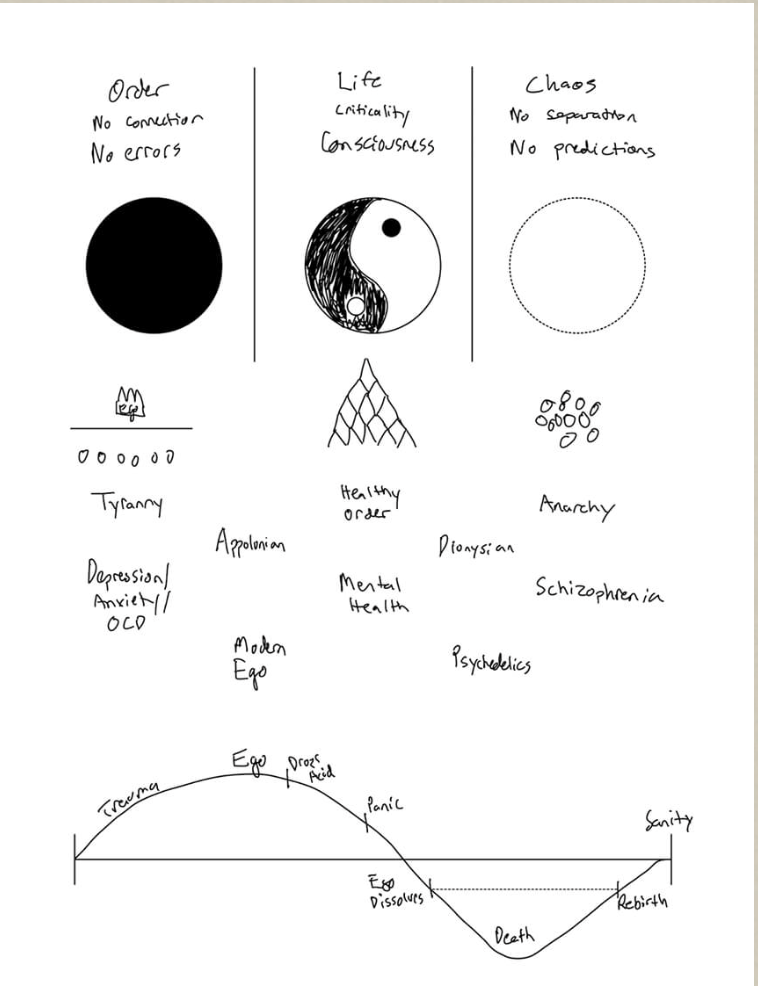
Order, Chaos, and the Story of Becoming
The same shape recurs across mythology, contemplative practice, psychotherapy, storytelling, and now neuroscience: transformation requires passing through a period of descent before a new configuration can emerge. A therapist on the universal arc of becoming, and why what feels like falling apart is often the necessary phase of real change.
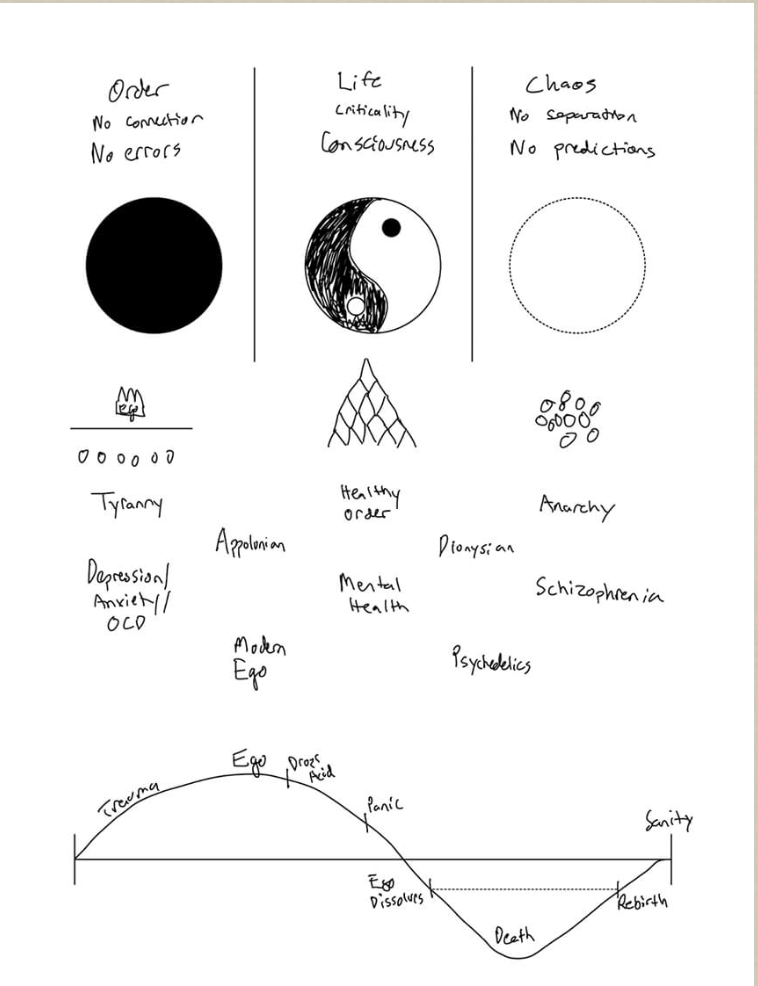
Illustrations from Guy Trefler, showing the applications of the spectrum across life, mind, and society.
There's a particular shape that transformation takes.
It's the shape Joseph Campbell traced through the world's myths and called the hero's journey. The shape Carl Jung mapped through the alchemists, calling it individuation. The shape trauma therapists watch their clients move through, sometimes over years. The shape every meaningful film follows, whether the screenwriter knows it or not. The shape contemplative traditions across cultures have described for thousands of years.
It's also the shape modern neuroscience is now describing, in the language of entropy, neural flexibility, and reorganization.
I want to walk through this shape, because once you see it, a lot of what looks like falling apart turns out to be something else. And once you can recognize when you're inside it, the experience changes, not because it becomes easier, but because you can stop interpreting it as failure.
What the Shape Actually Is
The shape isn't a straight line. It's a curve, and it has five recognizable phases.
Stability. A system (a person, a relationship, a culture, a way of being) has organized itself into a coherent form. There's an identity. A worldview. A set of patterns that work, more or less. The system can predict itself and its world.
This phase has gifts. Continuity. Function. The ability to plan. Most of life is lived inside it, and most of the time, it's where life should be lived. You can't grow continuously. You need long stretches of stability for the previous transformation to consolidate.
Disruption. Something breaks. A loss. A crisis. A relationship ending. A diagnosis. A profound experience; including, for some people, a psychedelic one. An illness. A truth that can't be unseen. A child leaving home. The death of a parent. The slow accumulating recognition that the life you've been living isn't quite yours.
The stable system meets something it can't absorb without changing.
Descent. This is the hardest phase, and the one most people don't realize is a phase. The structure that had been holding you starts to fail. The patterns don't quite work. The identity that had been clear becomes uncertain. You can't yet see what's coming, and you can't quite stay where you were.
In psychological terms, this is when the old self starts to dissolve before the new self has formed. It often feels like falling apart, like depression, like losing your mind. People in this phase frequently believe something is terribly wrong with them; that they've broken, that they need to be fixed, that they should be working harder to hold it together.
The mythological traditions call this the underworld. The contemplative traditions call it the dark night of the soul. Jung called it the descent. The neuroscience would call it the entropic phase; the period when the old configuration has loosened and the new one hasn't yet stabilized.
It is genuinely difficult. It is also genuinely necessary. There is no way to the new configuration except through this.
Letting Go. Somewhere in the descent, a shift happens. The person stops fighting what's been dissolving. They stop trying to put the old structure back together. They allow themselves to not know what comes next.
This isn't giving up. It's something closer to surrender, releasing the grip on a form that was already gone, accepting the uncertainty that the system actually requires in order to reorganize.
This phase is often the turning point. People who can let go tend to move through. People who keep trying to reassemble what was tend to get stuck in extended depression, anxiety, or a kind of half-life that goes on for years.
Rebirth. A new configuration emerges. Not the old one, recovered. Something different, usually wiser, often more whole, sometimes more useful. The person who comes through is recognizably the same person, but reorganized. The values may be different. The priorities have shifted. What used to matter doesn't, and what didn't seem to matter now does.
This isn't a fairy tale ending. The new configuration will eventually become its own form of stability, which will eventually meet its own disruption, and the cycle will turn again. But for now, something has been completed. The transformation that wanted to happen has happened.
Why This Shape Is Everywhere
The reason this same arc shows up across mythology, therapy, contemplative practice, and storytelling isn't coincidence. It's because the arc describes how change actually works in any complex living system.
Living systems can't transform continuously. They have to organize themselves into coherent forms in order to function. But the forms they organize themselves into eventually become limiting: too rigid, too narrow, too poorly matched to a world that keeps changing. At some point, the system needs to reorganize.
Reorganization requires a period of disorder. You can't go from one coherent form to another without passing through some loss of coherence. The old form has to dissolve before the new one can take shape. This is true of biological systems, of relationships, of cultures, of nervous systems, of psychological structures.
The descent phase, in this picture, isn't a malfunction. It's a feature. It's the necessary period of disorder that allows new order to emerge. Without it, the system can't actually change. It can only repeat itself with cosmetic variation.
This is why stories that don't have a real descent feel hollow. The protagonist who solves their problem without actually being undone by it hasn't transformed; they've just rearranged the furniture of an unchanged self. The stories that move us are the ones where the protagonist genuinely loses something, genuinely falls into uncertainty, and genuinely emerges different. We recognize the shape because we know it, even when we haven't named it.
What This Means Clinically
For people in the middle of this arc, naming it can be one of the most useful interventions there is.
The depression that arrived after the divorce isn't necessarily a diagnosis. It might be the descent phase of a transformation. The disorientation that's followed a major loss isn't necessarily a malfunction. It might be the necessary disorder that allows reorganization. The fear during a psychedelic experience that something is dissolving isn't necessarily a bad sign. It might be exactly what needs to happen for the experience to do its work.
This doesn't mean every difficult period is automatically a transformation. Sometimes depression is just depression and needs treatment. Sometimes anxiety is just anxiety and needs care. Not every dark phase has a redemptive arc.
But many of the long, painful, disorienting phases people live through are transformations in progress, and the cultural script, something is wrong with you, fix it, get back to normal as quickly as possible, actively interferes with the work the system is trying to do.
What helps, in these phases, isn't usually fixing. It's holding. The slow steady company of someone who can witness the descent without panicking, without trying to rescue, without insisting on a faster timeline than the system can support. The therapist who can sit with the dissolution. The friend who can be present without needing to fix. The contemplative practice that honors the disorder rather than fighting it. The relationship that doesn't end when one person stops being who they were.
This is part of why depth-oriented therapy works the way it does. It doesn't try to shortcut the descent. It supports the system through what the system needs to do, at the pace the system can sustain.
What This Means for Psychedelic Work
This arc has particular relevance for psychedelic experience.
A well-prepared psychedelic experience often produces, in compressed form, the same shape that life-scale transformations produce over years. The medicine softens the existing structure. The person passes through some form of descent, often involving fear, grief, or the dissolution of familiar identity. There's a moment of letting go. And something new comes into view.
This is why psychedelic experiences feel transformative, not because they install new beliefs or produce new insights, but because they put the person through a compressed version of the actual arc of change. The system gets to do, in a few hours, what would otherwise take years.
The risk is that without preparation and integration, the arc gets cut short. The descent gets framed as a bad trip. The letting go doesn't quite happen. The rebirth doesn't consolidate because there's no infrastructure of life to support it. The medicine produced the conditions for transformation; the surrounding work needed to support it didn't happen.
This is part of why integration is so important. The arc has to be allowed to complete. The new configuration that emerged during the experience needs sustained support to take root in ordinary life. Without that, the person glimpsed something but didn't become someone who can live it.
What This Looks Like When You're In It
If you're reading this and recognizing yourself in the descent, the disorientation, the loss of clear identity, the sense that what worked isn't working anymore, there are a few things worth holding.
This phase is harder when you fight it. The cultural script will tell you that you should be productive again by now, that you should have figured it out, that the disorientation is a problem to solve. Letting these messages drive you tends to keep you in the descent longer, not less long.
Real support helps. Not the kind of support that tries to talk you out of where you are, but the kind that can witness it. A therapist who understands transformation. A friend who can be present without needing to fix. A contemplative practice that gives the disorder a container.
Slowing down often helps. The descent often coincides with a slowing of energy, motivation, and clarity. This isn't laziness. It's often the system pulling resources inward for the reorganization work that's happening underneath. The activity that the old self had been sustaining isn't quite available anymore, and trying to maintain it can make the whole process longer.
The body needs more, not less: sleep, food, movement, time outside, time with people who care about you. The reorganization is happening in your nervous system, in your body. Treating yourself with care during this phase isn't indulgence. It's part of how the system actually does the work.
And the descent does end. Not always when you want it to. Not always how you expect. But the arc has a shape, and the descent is not the destination. Something new is trying to form. Your job, much of the time, is to allow the formation to happen at the pace it can happen, and to not abandon yourself while it does.
A Closing Reflection
What I find most useful about this arc, both clinically and personally, is what it suggests about what change actually requires.
We tend to want growth without descent. Transformation without loss. New configurations without the disorder of the old one dissolving. The cultural fantasy is of continuous, painless improvement, a self that keeps getting better in a straight upward line.
The actual shape of change doesn't work that way. The systems that transform are the ones that pass through periods of disorder. The selves that genuinely become more whole are the ones who let the old self come undone. The lives that deepen are the ones that include real descent, not just rearrangement.
This isn't a counsel of despair. It's the opposite. It means that what feels like falling apart is often the necessary phase of becoming. The moments that look like failure, from inside, are often the system doing exactly what it needs to do.
If you're in one of those moments now, you are not broken. You are not failing. You are not going backward. You may be exactly where you need to be, doing exactly what the next configuration of your life requires.
If you'd like a place to be held through that work — through depth-oriented therapy, integration support, or contemplative practice — you're welcome to book a consultation.
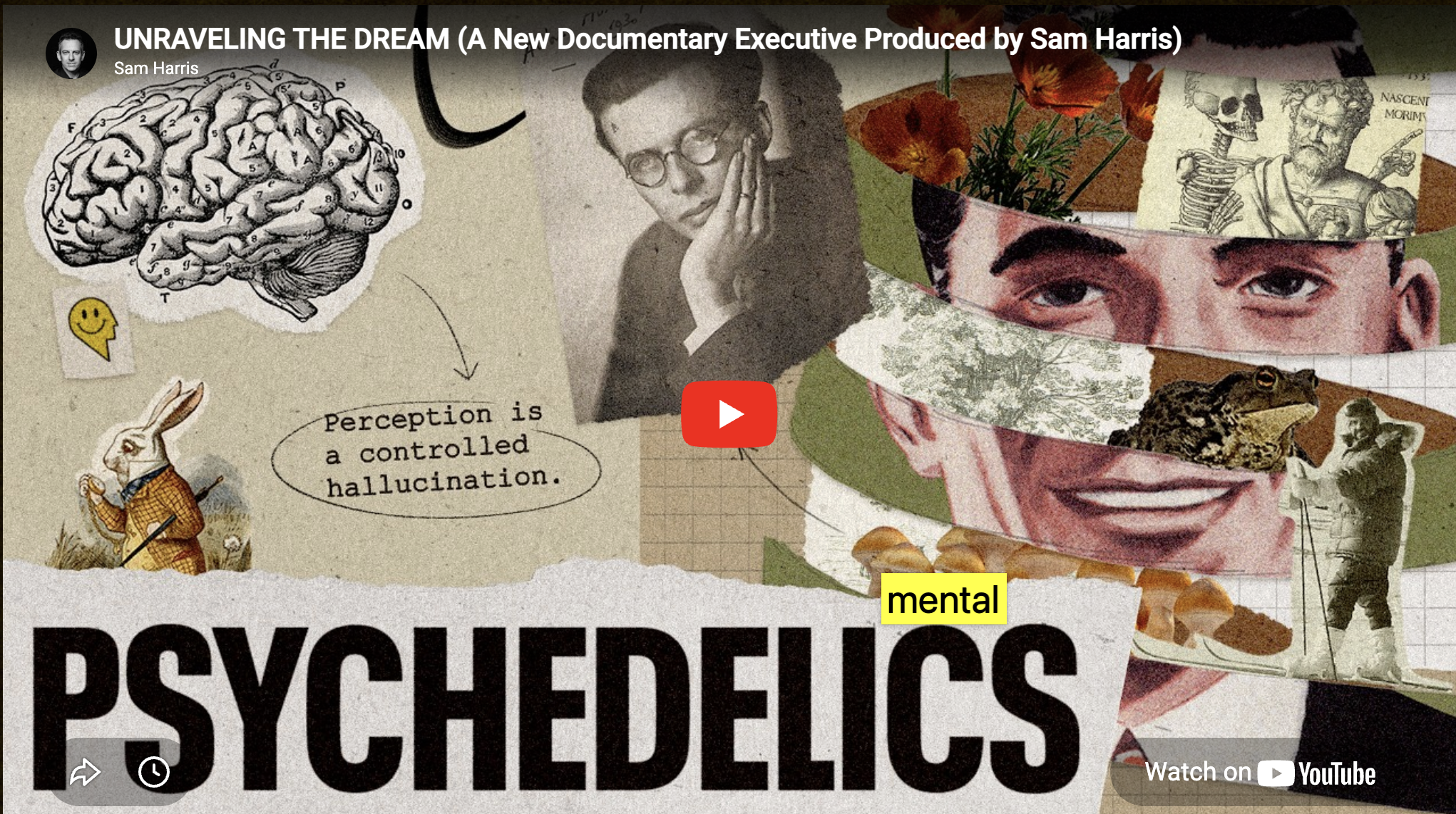
A Recommended Watch: Unraveling the Dream
A new documentary from the Waking Up app, executive produced by Sam Harris and featuring Anil Seth, Robin Carhart-Harris, and Shamil Chandaria, makes a clinically important distinction: psychedelic experiences produce states, but contemplative practice produces traits — and traits are what actually change a life. A therapist's brief recommendation and a note on what the distinction means for integration.
There's a film I'd recommend if you're sitting with questions about consciousness, psychedelics, meditation, or what these conversations have to do with each other.
It's called Unraveling the Dream: Psychedelics, Awakening, and the Brain. Released in April 2026, directed by Jake Orthwein, executive produced by Sam Harris and Jaron Lowenstein, and produced by the Waking Up meditation app. It runs about an hour and is freely available on YouTube.
The film traces a single thread that I think more people need to encounter. It starts with Aldous Huxley's 1953 mescaline experiment — the experience that produced The Doors of Perception and seeded most of what came after in Western psychedelic culture. From there it moves through the contemporary neuroscience of consciousness, drawing on interviews with three of the most important thinkers in the field: Anil Seth, Robin Carhart-Harris, and Shamil Chandaria.
What makes the film unusual is that it doesn't quite fit either of the standard genres of psychedelic content. It isn't an enthusiast piece selling the medicines as the next mental health revolution. It also isn't a cautionary takedown. It sits in a more honest place, and the question it ends with is one I find clinically important.
What the Film Actually Argues
The central insight, developed across the film's hour, is a distinction that's easy to miss in most psychedelic conversation.
Psychedelic experiences can produce profound states. The boundaries of the self loosen. Ordinary perception becomes vivid in ways that feel revelatory. Material that ordinarily sits beyond conscious reach can come into view. For many people, these experiences are among the most significant of their lives.
But a state is a temporary thing. It happens, and then it ends. The brain returns, mostly, to its baseline configuration. The patterns that produced the suffering in the first place reassert themselves. And the person is left with the memory of having glimpsed something, without necessarily having become someone who can live it.
The film's argument, drawing on the contemplative tradition that Waking Up represents, is that traits are what actually change a life. Not states. Traits, durable changes in how the underlying system organizes itself, built over time through repeated practice, are what last. And the practice that builds them is, in this view, primarily contemplative.
Or, in the film's framing: destroying the ego is a chemical event that lasts four to six hours. Transcending it is a skill, and developing that skill is the work of years.
Why This Distinction Matters Clinically
I see this constantly in clinical work.
People come back from powerful psychedelic experiences with vivid memories of what they encountered, sometimes with sustained behavioral changes for weeks or months, and then often with a gradual return of the patterns that brought them to the medicine in the first place. The state was real. The change it produced was real, while it lasted. But without something that helps the underlying configuration of the mind actually shift, the door that opened tends to close.
This is part of what good integration work is for, and part of what's missing in much of the current commercial psychedelic landscape. The medicine alone, even when it produces profound experiences, doesn't reliably produce lasting trait change. What seems to matter more is what happens afterward; the slow work of bringing what was glimpsed into the structure of ordinary life.
For some people, this happens through ongoing contemplative practice. Daily meditation, in particular, appears to be one of the most reliable ways of consolidating the openness that a psychedelic experience can briefly produce. The medicine shows you something; the practice helps you slowly become someone who can hold what you saw, not as a memory of a peak experience but as a present-tense quality of how you live.
For others, it happens through depth-oriented therapy that takes the experience seriously and works with it over time. For others, through community, ritual, or other forms of sustained practice. The form matters less than the underlying fact: states are not enough on their own, and traits are what allow real life to actually shift.
What I'd Take From the Film
A few things the film does well that I think are worth sitting with:
It's honest about the limits of psychedelic experience. It doesn't suggest that the medicines fix anything on their own, and it explicitly points to the work that has to surround them for the openings they produce to actually take root.
It's grounded in the actual neuroscience, with serious interviews rather than dramatic claims. Seth on consciousness as construction. Carhart-Harris on the entropic brain. Chandaria on the bridge to contemplative tradition. The interviews give you something substantive to think with.
And it asks the right closing question, not should you take psychedelics, but what kind of practice would let you actually live the freedom these experiences can sometimes glimpse?
That question is, I think, the most important one to bring out of any encounter with psychedelic experience, whether you're considering one or integrating one you've already had. The medicine, when it works, opens a door. What you do with the open door is where the actual change lives.
Where to Watch
The film is freely available on YouTube on the Waking Up channel. The link is here. It's about an hour, and worth setting aside the time rather than half-watching.
If you find yourself moved by the questions it raises — about meditation, integration, or what serious work with these experiences could look like for you — you're welcome to book a consultation.
How Consciousness Emerges Through the Body
Consciousness isn't produced by the brain in isolation — it emerges continuously from the conversation between brain, body, and environment, with interoception and proprioception as constitutive elements of experience itself. A therapist on what this picture means for healing, for psychedelic integration, and for why working only with the mind often leaves the patterns that hurt us untouched.
There's a moment that often happens in deep therapeutic work, and especially in psychedelic experience, that defies the way most of us were taught to understand the mind.
A client begins to cry, not because they were thinking sad thoughts, but because something has begun to release in their chest, their throat, their belly. The tears come from somewhere underneath language. They don't know exactly what they're crying about. The body, in some way they hadn't been tracking, has been carrying this all along.
Or someone in the middle of a psychedelic experience suddenly understands something, not as a thought arriving in their mind, but as a felt sense moving through their whole system. The understanding is bodily before it becomes verbal. By the time they can put it into words, the words feel like a translation of something that happened in a different language.
These moments are common in depth work, and they point at something the dominant Western model of consciousness has long had trouble accommodating: that the body isn't a vehicle the mind rides around in. The body is part of how the mind happens. Consciousness isn't located somewhere inside your skull; it's something that emerges, continuously, from the ongoing conversation between brain, body, and world.
This isn't mysticism. It's increasingly the conclusion of contemporary neuroscience. And a 2015 paper in Frontiers in Psychology by Payne, Levine, and Crane-Godreau — Somatic Experiencing: using interoception and proprioception as core elements of trauma therapy — articulates one of the clearest applications of this picture to the question of how healing actually works.
I want to walk through this carefully, because it underlies a great deal of what makes Path of the Pearl's approach distinct, and because it explains why psychedelic experience, and the integration work that follows, has to reach the body if it's going to reach anything that lasts.
The Old Picture and Its Limits
For most of the twentieth century, the dominant model treated the brain as an information processor. Sensory data comes in, gets analyzed, and conscious experience is the output. The body shows up in this picture as a delivery system for sensory input and a recipient of motor commands, but the consciousness itself happens in the brain.
This model has been productive scientifically. It also has serious limits that have become harder to ignore.
It struggles to explain why bodily states so reliably alter mental ones. Why slow breathing genuinely calms anxiety in ways that thinking about being calm doesn't. Why posture affects mood, why hunger affects judgment, why fatigue changes what you believe about your life. The brain-as-isolated-processor model treats these as side effects. The lived experience suggests they're closer to the main event.
It also struggles with phenomena that contemplative and somatic traditions have known about forever. Why moving the body changes the mind. Why breath work reliably produces shifts in consciousness. Why people who carry trauma in their bodies often can't be reached through talk alone, and why those who learn to listen to the body can sometimes access material that conversation never quite touches.
The newer view that's emerging across cognitive science is what's sometimes called embodied cognition or embodied consciousness. The premise is straightforward: the brain, the body, and the environment aren't three separate systems that occasionally interact. They're one continuous system, and what we call consciousness is what that system does.
The Inside View: Interoception
One of the most important pieces of this picture is interoception — your brain's ongoing perception of the internal state of your body.
You don't usually think about interoception explicitly, but it's running constantly underneath your conscious experience. Your brain is continuously tracking signals from inside you: heartbeat, breath, gut sensations, muscle tension, blood pressure, temperature, the subtle felt sense of being a body. These signals aren't background noise. They're constitutive of how you feel, what you notice, and even what you think.
When you're anxious, much of what you experience as anxiety is interoceptive: your awareness of your racing heart, your tight chest, your shallow breath. When you're calm, interoception reports something different: slower heart, deeper breath, softer belly. The thoughts that arise on top of these states tend to match them. Anxious bodies produce anxious thoughts. Calm bodies produce calmer thoughts. The direction of causation runs both ways, but interoception is doing far more of the work in shaping experience than most people recognize.
This is why directly working with the body's internal state often changes what's happening psychologically faster than working with the thoughts. Slow your breath, and the anxious cognitions begin to soften, not because you've talked yourself out of them, but because the interoceptive substrate that was generating them has shifted.
It's also why, for people whose interoceptive signal has been disrupted, which is common in trauma, the work of healing involves rebuilding access to the body's inner life. When the connection between conscious awareness and bodily sensation has been severed, the system loses one of its most important regulatory tools. Restoring that connection, slowly, is often a central piece of trauma therapy.
The Outside View: Proprioception and Movement
There's a second layer too: proprioception, your sense of where your body is in space, how it's positioned, how it's moving.
Like interoception, proprioception runs continuously and mostly outside conscious awareness. You don't have to think about where your hand is; you just know. You don't have to direct each step; you walk. The proprioceptive system is what allows the body to move through the world without constant deliberate guidance.
What's interesting clinically is that proprioception, like interoception, is bidirectional. Moving your body changes your mental state in measurable ways. The slow, careful movement of yoga or qi gong doesn't just feel good, it actually shifts the brain's processing patterns. The rhythmic movement of walking has been shown to facilitate emotional integration in ways that sitting still doesn't. The forms of movement traditional cultures have used for healing for thousands of years, dance, ritual movement, ceremony, engage the proprioceptive system in ways that produce real psychological change.
The Payne, Levine, and Crane-Godreau paper specifically focuses on how interoception and proprioception together form the foundation of somatic approaches to trauma healing. Both are routes into the system where so much of suffering actually lives. Both can be trained, refined, and used as instruments of healing in ways that purely cognitive approaches can't replicate.
The Self as Embodied Process
If consciousness is genuinely embodied, then the self is too.
The felt sense of being you, the experience of being a continuous person across time, the sense of being inside your own life, isn't generated by some isolated process in the brain. It's constructed continuously from the integration of bodily signals, sensory input, memory, and the ongoing experience of being a particular animal moving through a particular world.
This means the self isn't quite the fixed thing we usually experience it as. It's a process. Your self right now is being generated, in real time, by your nervous system's interpretation of your body's current state in your current environment. Change the body's state significantly enough, and the self changes too.
This is why posture, movement, breath, and physical state can shift identity in ways that surprise us. The exhausted self at the end of a hard day is genuinely a different self than the rested one. The anxious, contracted self in fight-or-flight isn't who you are in any deeper sense, it's who your nervous system is configured as right now, and reconfiguring the nervous system reconfigures the self.
This perspective also helps make sense of what people often experience in psychedelic states and deep meditative practice. The felt sense of self can become much more obviously a construction during these states, sometimes loosening in ways that reveal its underlying mechanisms. People come back from such experiences with a different relationship to their own identity, not because they've stopped being themselves, but because they've seen, directly, how their self is being produced, moment to moment, from the underlying system.
Why This Matters for Psychedelic Work
This whole picture is foundational to why psychedelic-assisted therapy and integration work has to reach the body, not just the mind.
Psychedelics produce profound shifts in interoceptive and proprioceptive experience. The boundaries of the body become more fluid. Internal sensations become more vivid. The felt sense of being a self gets reorganized at the level of the bodily substrate that ordinarily produces it.
What this means clinically is that what's happening during a psychedelic experience is not primarily intellectual. It's somatic. The insights that arise, even the ones that feel like cognitive realizations, often emerge from bodily reorganization that's happening underneath. The work of integration, then, has to honor this. You can't fully integrate a psychedelic experience through talk alone, any more than you can fully integrate any deep experience through talk alone. The body that participated in the experience has to participate in the integration.
This is why the most thoughtful psychedelic practitioners pair the medicine work with somatic approaches. Somatic Experiencing. Internal Family Systems with attention to body sensation. Hakomi. Touch-informed work where appropriate. Breath work. Movement practices. Body-aware mindfulness. The medicine opens something; the somatic work helps the opening land in the body where it can actually take root.
Without this dimension, psychedelic experiences can produce strong cognitive impressions that fade as the brain returns to its baseline patterns. With it, the same experiences can produce lasting changes in how the person inhabits their body and their life.
Why This Matters for All Healing
Even beyond psychedelic work, this picture has implications for how to think about healing more broadly.
Many of the people I work with come in expecting therapy to be about understanding. Identify the pattern. Trace it to its origin. Develop better strategies. This is part of what therapy does, and it matters. But by itself, it often doesn't reach where the patterns actually live.
The anxiety that runs through your day isn't only in your thoughts. It's in your shoulders. In your breath. In your gut. In the way you hold yourself when you enter a room. The depression isn't only in your beliefs about life. It's in the heaviness of your body, the slowed metabolism, the way movement has dropped out of your days. The trauma isn't only in your memories. It's in the bracing pattern your nervous system has carried for decades.
Working only with the mind, while leaving the body untouched, often produces a partial change. You understand more, but the underlying state remains. The patterns return because the substrate that generates them is still configured to generate them.
The work that produces lasting change usually involves both. The cognitive understanding and the embodied reorganization. The new perspective and the new way of breathing. The processed memory and the released tension that was holding it.
Good therapy at depth, regardless of whether it involves any psychedelic medicine, attends to the body throughout. It tracks the breath. It notices what's happening in the chest, the throat, the belly. It treats the body as a participant in the conversation, not just a vehicle delivering the client to the chair.
What This Looks Like in Practice
A few small practices that honor this picture:
Before any conversation, check in with your body. What's the felt sense in your chest right now? Your stomach? Your shoulders? Most of us walk through our days without doing this even once. The thirty seconds of attention can change what's available in the next hour.
Notice the body's signals during difficult moments. When you're activated — angry, anxious, defensive — the body is usually doing something specific. Tightening, holding, bracing. Noticing it without trying to change it is itself a regulatory act. You're bringing the body into the conscious system, and that alone often shifts something.
Move when you're stuck. When thinking has become circular and unproductive, the body often holds the next step. A walk. Stretching. Slow breathing. Lying on the floor for ten minutes. The thinking mind will tell you it's a distraction. Sometimes it's the opposite — the thinking is the distraction from what the body is trying to tell you.
Take seriously what your body knows. The felt sense that something isn't right, even when you can't say why. The somatic relief when something resolves. The tension that arises around certain people, places, or topics. These aren't unreliable. They're often more accurate than the thoughts that try to override them.
Consider somatic approaches when patterns won't shift. If you've done years of therapy and certain patterns still grip you, the missing piece may be at the level of the body. Somatic Experiencing, Hakomi, Sensorimotor Psychotherapy, somatic IFS, and breath-based practices can reach places that cognitive work alone hasn't quite touched.
A Closing Reflection
The Western philosophical tradition, going back to Descartes, treated the mind and body as separate substances. I think, therefore I am, the thinking is the self; the body is something else. This split has shaped medicine, psychology, and culture for centuries.
The contemporary picture that's emerging, from neuroscience, from contemplative traditions, from somatic therapy, and now increasingly from psychedelic research, points in a different direction. The mind and body aren't separate. They're aspects of one living process. What you experience as your mind is what your whole organism is doing, in interaction with the world it lives in.
This isn't a loss of the mind's importance. It's a recovery of something the body always knew. The animal you are has wisdom that the thinking mind doesn't have direct access to. Healing — and especially the kind of deep, lasting change that psychedelic and depth work aim toward — involves rebuilding the conversation between these two aspects of yourself.
The body has been participating in your life the whole time. The question is whether the conscious mind will start listening.
If you'd like to explore depth-oriented work that takes the body seriously — whether through somatic therapy, integration support for past or future psychedelic experiences, or contemplative practice — you're welcome to book a consultation.
The Missing Piece in Psychedelic Therapy: How We Make Meaning of What We Experience
Clinical papers on psychedelic therapy describe receptors and symptom scores. They rarely describe what patients actually experience: the sense of having met God, or understood the universe, or seen what a life is for. A therapist on the Emory group's argument that meaning-making belongs in the treatment model, and what happens in the room when it's left out.
There's a strange omission in much of the clinical literature on psychedelic therapy.
The research papers will tell you about neuroplasticity, about serotonin receptors, about the default mode network and predictive processing. They'll describe the symptom changes: depression scores dropping, anxiety subscales improving, addiction patterns loosening. The mechanism gets traced through brain imaging, neurotransmitter activity, network dynamics.
What they often don't address is what people actually experience.
Not the activated receptors. The sense of having met God, or having understood the universe, or having encountered a deceased grandmother, or having recognized that everything is connected, or having confronted their own mortality, or having seen, in a way they can't put into words, what their life is for. These aren't side effects of the medicine. For many people, they are the heart of what happened.
A 2023 special communication in JAMA Psychiatry, Importance of Integrating Spiritual, Existential, Religious, and Theological Components in Psychedelic-Assisted Therapies, addresses this gap directly. Palitsky, Kaplan, Peacock and colleagues at Emory argue that the spiritual, existential, religious, and theological dimensions of psychedelic experience are not peripheral. They may be central to how healing actually happens. And current clinical models, by failing to systematically address them, are leaving a significant part of the work undone.
It's worth being clear about what kind of paper this is. A special communication is an argument, not a study. The authors aren't reporting new data on how often these problems occur. They're making a case, built from existing evidence and from parallel work in spiritually integrated psychotherapy, that the field has a gap it needs to close. That's a reasonable thing to do and I find the case persuasive. But it's a call to action rather than a measurement.
I want to walk through it carefully, because I think the paper names something that matters enormously for the future of psychedelic therapy, and for the broader question of what any depth-oriented therapy is actually for.
What Most Clinical Models Miss
Modern psychedelic therapy follows a three-phase structure: preparation, the experience itself, and integration. Within each phase, there's usually careful attention to safety, screening, expectation-setting, emotional support, and basic therapeutic principles.
What's often missing is a framework for working with the meaning-making that almost inevitably arises.
People emerge from psychedelic experiences having encountered material that doesn't fit neatly into clinical categories. I felt like I was dying, and it was okay. I saw what I came here to do. I forgave my mother in a way I never thought possible. I understood, for those hours, that love is the actual fabric of reality. I met a presence I can only call sacred.
These aren't symptoms to be managed. They're not delusions to be corrected. They're not metaphors to be translated into psychological terms. They are the substance of the experience for many people, and the work of integration involves figuring out what to do with them.
But the clinical models rarely address how. Most psychedelic therapy training, even in established programs, treats spiritual and existential material as something the therapist is expected to navigate intuitively, without formal preparation. Some therapists handle this well. Many handle it poorly, either dismissing the meaning-making as epiphenomenal, or unwittingly imposing their own metaphysical assumptions, or simply not knowing what to do when a patient describes experiences that exceed the framework they were trained in.
The paper proposes that this needs to change. Not because every patient is spiritual or religious, but because all patients are meaning-making creatures, and psychedelic experiences amplify exactly the dimensions of life where meaning is most actively constructed.
The SERT Framework
The paper organizes these dimensions into four overlapping domains, captured by the acronym SERT. Worth noting for anyone reading the psychedelic literature: SERT also stands for the serotonin transporter, so context matters when you encounter it.
Spiritual: the felt sense of connection to something larger, sacred, or deeply meaningful. This doesn't require any particular belief system. Atheists, agnostics, and people of all religious traditions can have spiritual experiences in this sense.
Existential: the human confrontation with mortality, meaning, identity, freedom, and the basic conditions of existence. The questions that arise when ordinary distraction falls away and life's underlying realities become unavoidable.
Religious: the structured belief systems, communal practices, and cultural traditions through which many people have historically organized spiritual and existential experience. Religion provides language, ritual, and community for what would otherwise be entirely private.
Theological: the more developed attempts to articulate the nature of ultimate reality, the divine, and the structures that might lie beneath ordinary experience. The intellectual and philosophical work of trying to make sense of what's been encountered.
These four domains aren't separate compartments. They overlap and inform each other. Together they describe the dimension of human life where deep meaning is made, the same dimension that psychedelic experiences so often touch directly.
Clinical work with psychedelic experience that ignores all four of these dimensions isn't neutral. It's incomplete. And incomplete care, in vulnerable states, can do harm.
What Happens Without This Framework
Without a framework for meaning-making, several predictable problems emerge.
Patients get left alone with experiences they can't make sense of. Someone has a profound mystical encounter during a session. They leave wanting to talk about it. The therapist, lacking framework or training, redirects toward symptom management or cognitive integration. The experience gets quietly sidelined. The patient is left to figure out what it meant on their own, often without the contemplative or theological resources to do this well.
Therapists impose their own beliefs. A therapist with no formal training in spiritual care will inevitably bring their own assumptions into the room. A secular materialist therapist may unconsciously communicate that the patient's mystical experience was just their brain doing something. A spiritually inclined therapist may encourage interpretations that align with their own beliefs. Neither is neutral. Both can shape, sometimes coercively, what the patient comes to believe about their own experience.
Patients with religious frameworks get inadequate support. A devout Christian who has a psychedelic experience that doesn't fit her theology may feel deeply disoriented. A Jewish patient who encounters something that feels like the divine may need to integrate that within his existing spiritual life. Many clinical settings have no infrastructure for engaging with specific religious frameworks, even though the patient's religious life is often centrally relevant to how they'll integrate the experience.
Secular patients get inadequate support too. A secular patient may have an experience that destabilizes their worldview. They emerge convinced of things they didn't believe before. Without help, they may either uncritically adopt new metaphysical commitments or repress what they experienced because it doesn't fit their existing framework. Either response leaves the integration incomplete. This is the territory Chris Letheby maps carefully in his work on what psychedelic experiences can and can't tell us about reality.
Spiritual distress goes unaddressed. Not all psychedelic experiences are positive. Some involve profound existential distress: feeling abandoned by God, encountering darkness that doesn't resolve, losing a faith that previously felt secure, confronting mortality in ways that produce lasting fear. Clinicians without training in spiritual care often don't recognize these as the spiritual emergencies they are, and the patient is left without adequate support.
Why Psychedelics Specifically Amplify This Need
There's a specific reason this matters more here than in many other forms of clinical work.
Psychedelics increase what researchers call cognitive flexibility and suggestibility. The rigid filters through which we ordinarily organize experience loosen. New patterns can form. Existing patterns can be revised.
This is part of what makes the medicines therapeutically valuable. It's also what makes them ethically demanding. In a state of increased suggestibility, what the patient is exposed to has unusual influence. What the therapist says. What the music suggests. What the cultural context implies. What the patient already half-believed. The window in which new meaning gets made is unusually wide. It's the same reason set and setting aren't soft variables in this work.
For meaning-making specifically, this matters enormously. The interpretations a patient forms during and immediately after a psychedelic experience often consolidate into how they'll understand the experience long-term. If those interpretations are guided thoughtfully, with attention to the patient's own values and tradition, integration tends to go well. If they're guided poorly, or not guided at all, the patient may end up with conclusions that don't serve them, sometimes with effects that persist for years.
This is part of why psychedelic therapy isn't just pharmacology. It's a kind of clinical work where the meaning context the therapist creates is itself part of the medicine. Or, when handled badly, part of the harm.
The Particular Difficulty for Therapists
I want to be honest about how difficult this is from the therapist's side.
Most therapists are trained, appropriately, in maintaining a kind of neutrality about patients' spiritual and existential lives. We're taught not to impose our own beliefs, not to evaluate the truth of religious convictions, not to direct patients toward particular metaphysical conclusions. This neutrality serves patients well in most clinical settings.
But psychedelic therapy challenges this stance in specific ways. Patients in altered states are bringing material that requires engagement. They're often asking, sometimes directly, what their therapist makes of what just happened. They want to know if it was real. They want to know what to do with it. They want help making sense of an experience that doesn't fit easily into their existing frameworks.
A therapist who maintains complete neutrality here can come across as dismissive or absent. A therapist who engages without care can impose. Finding the middle path, being substantively present without becoming directive, requires both training and personal preparation that most current programs don't adequately provide.
This is also, not coincidentally, the same problem that sank the FDA application for MDMA-assisted therapy. When the therapy component isn't specified clearly enough to be reproduced, nobody can say what's being tested or what standard a practitioner is being held to. Meaning-making is the hardest part of the therapy to specify, and the part where getting it wrong does the most damage.
The paper's recommendation is that psychedelic-assisted therapy programs need to systematically include training in spiritual and existential care. Not turning therapists into chaplains or spiritual directors, but giving them the tools to recognize when these dimensions are active, to support patients in their own meaning-making rather than imposing the therapist's, and to refer or consult when more specific expertise is needed.
Worth noting that the same Emory group has kept working on this. In 2025 they published a follow-up in Psychotherapy applying a relational spirituality model to develop spiritual and religious competencies in psychedelic-assisted psychotherapy training, along with a critical evaluation of psilocybin-assisted therapy protocol components drawing on clinical trial patients, facilitators, and caregivers. The 2023 paper called for a curriculum. They've started building one.
How This Might Look in Practice
What would good integration of meaning-making look like?
Preparation that includes meaning. Before the session, exploring with patients what meaning systems they already work within. What gives their life meaning now? What spiritual or religious frameworks have shaped them? What existential questions have they been sitting with? What would they like to be open to during the experience? This gives the therapist a sense of the patient's existing meaning architecture, which helps the integration that comes later.
Non-directive presence during the experience. Skilled facilitators learn to support whatever arises without steering it toward particular interpretations. Notice what's here. Be with what comes. Let it move you wherever it wants to move you. The work isn't to install meaning. It's to make space for the patient's own meaning to emerge. Part of what makes this possible is that two nervous systems in a room are already regulating each other, whether or not anything is said.
Integration that honors the meaning as well as the symptoms. After the experience, integration sessions should make explicit room for the spiritual and existential material, not just the psychological. What did you experience that felt sacred? What questions does this raise for you about your life? Has anything shifted in how you understand your purpose, your relationships, your mortality? These are integration questions, not just clinical ones.
Referral and consultation when needed. Therapists shouldn't be expected to be experts in every religious tradition, every theological framework, every philosophical system. Building referral networks with chaplains, spiritual directors, religious teachers, and contemplative practitioners who can be consulted as appropriate to the patient's tradition should be part of good psychedelic therapy infrastructure.
Honest acknowledgment of the limits. A therapist isn't a theologian or a spiritual teacher. Being clear about what the therapist can and cannot offer, and supporting patients in finding the right resources for the questions they're sitting with, is itself part of responsible care.
A Wider Lens
What I find most clinically valuable about the paper is something its authors only touch on implicitly. This isn't really a problem specific to psychedelic therapy.
It's a problem in most contemporary mental health care.
For much of the 20th century, clinical psychology distanced itself from religious and spiritual frameworks as a way of establishing itself as a serious science. The cost was that the meaning-making dimension of human life, the dimension where mortality, purpose, identity, and the sacred live, got increasingly handed off to people who weren't psychologically trained, or simply got ignored.
This worked, sort of, in eras when most patients had robust religious frameworks of their own. People could do the meaning-making outside therapy, in church, in community, in the structured rituals of their tradition. Therapy could focus on the psychological without addressing the existential, because the existential was being addressed elsewhere.
That arrangement has been quietly breaking down for decades. Many of my patients don't have religious frameworks they're embedded in. Many were raised in traditions they've left and haven't replaced. Many are spiritually serious but unaffiliated. Many are atheists or agnostics for whom existential questions remain real without a religious context. The meaning-making dimension of their lives has nowhere external to land. It's all happening inside, often unsupported, often as low-grade chronic distress that gets called depression or anxiety because we don't have better language for it.
This is part of why so many people are turning toward psychedelic therapy, contemplative practice, Indigenous traditions, and other forms of meaning-making the mainstream mental health system hasn't been able to provide. Not because traditional therapy is failing on its own terms, but because the existential dimensions of suffering aren't being addressed anywhere, and people are starving for them.
What the paper is naming, specifically about psychedelic therapy, points to a broader truth. Good care of human suffering eventually has to include the meaning-making dimension. The depression isn't only chemical. The anxiety isn't only cognitive. The grief isn't only emotional. Underneath, in most of the people I see, are existential and spiritual questions that need to be honored, examined, and supported.
What This Means for Path of the Pearl's Work
This is part of why I work the way I do.
Path of the Pearl is anticipating a future in which psilocybin and other psychedelic medicines will be legally available for therapeutic use in California. The technical aspects of that work, preparation and safety and dose and integration, matter enormously. But they're not the whole picture.
The deeper work, in my view, is creating clinical space where the spiritual, existential, and meaning-making dimensions of psychedelic experience can be held with care. Not by imposing any particular framework. Not by claiming expertise in any patient's specific tradition. But by recognizing that these dimensions are active in almost every meaningful psychedelic experience, by being able to sit with them without flinching or directing, and by helping each patient find their own way through what's been opened.
This requires training beyond standard clinical psychology. It requires the therapist's own contemplative and existential work. It requires building relationships with chaplains, spiritual directors, and teachers across traditions who can be consulted appropriately. It requires honesty about the limits of what any one practitioner can offer.
For me this isn't a separate add-on to clinical work. It's part of what depth-oriented therapy has always been about, made more visible by the demands of working with psychedelic experiences. The same questions that arise vividly under the medicine, what is my life for, what happens when I die, what is sacred, who am I underneath the story I've been telling, are quietly present in most of the work I do, whether or not any medicine is involved.
A Closing Reflection
The paper's central argument is, in a way, an old one dressed in clinical language. Healing is not just biological. It's not even just psychological. It's also about how we make sense of being alive: what we take to be sacred, what we believe gives our lives meaning, how we understand our place in the larger reality we're part of.
For thousands of years, traditional cultures have known this. The healing arts were embedded in larger frameworks of meaning that were religious, communal, and ceremonial. Modern Western medicine separated the biological from the spiritual for good reasons, but at a cost.
Psychedelic therapy is, in some sense, forcing the conversation back to where it needs to be. The medicines produce experiences that won't fit into purely biological or psychological frameworks. They demand to be addressed at the level where meaning is made. Clinicians who try to work with these medicines while avoiding the meaning-making dimension are increasingly recognizing that they can't.
This is hopeful, I think. Not because it means we're returning to pre-modern frameworks, but because we're being asked to develop new ones. Frameworks that take both science and meaning seriously. That honor both the brain and the soul. That can hold both the patient's symptoms and their deepest questions.
The work is just beginning. The current clinical models are inadequate to it. But the direction is clear, and the resources exist, in contemplative traditions, in existential psychology, in interfaith chaplaincy, in Indigenous wisdom traditions. The question is whether the field can grow into them.
If you'd like to explore what depth-oriented work that honors the meaning-making dimension might look like for you, you're welcome to book a consultation.