Order, Chaos, and the Story of Becoming
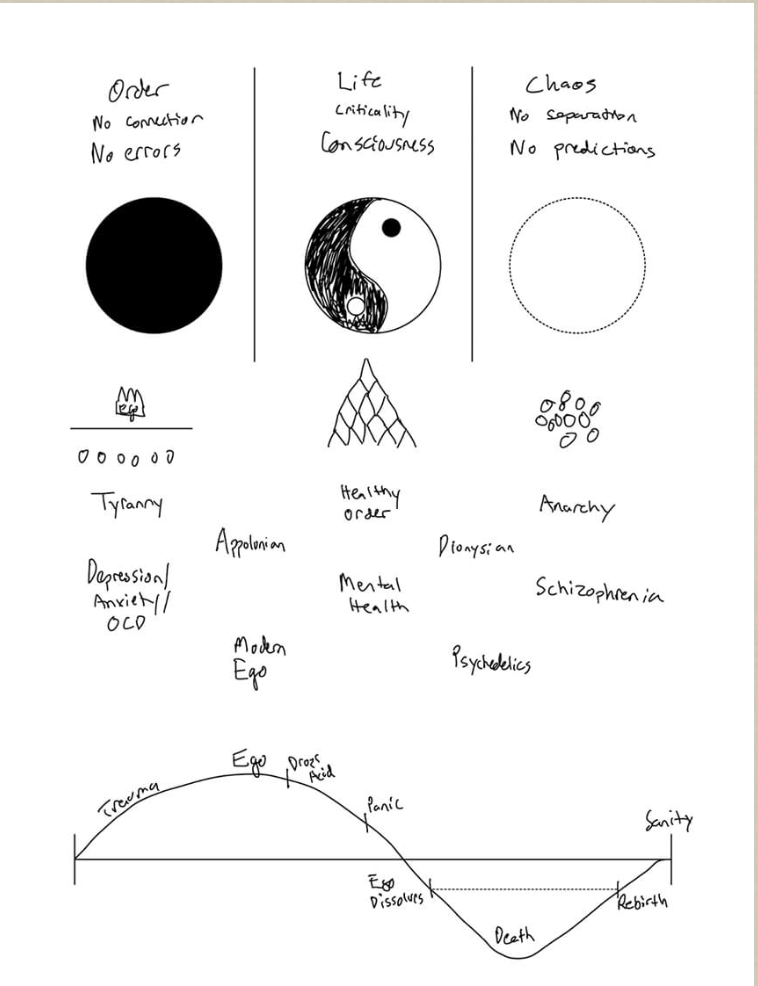
Illustrations from Guy Trefler, showing the applications of the spectrum across life, mind, and society.
There's a particular shape that transformation takes.
It's the shape Joseph Campbell traced through the world's myths and called the hero's journey. The shape Carl Jung mapped through the alchemists, calling it individuation. The shape trauma therapists watch their clients move through, sometimes over years. The shape every meaningful film follows, whether the screenwriter knows it or not. The shape contemplative traditions across cultures have described for thousands of years.
It's also the shape modern neuroscience is now describing, in the language of entropy, neural flexibility, and reorganization.
I want to walk through this shape, because once you see it, a lot of what looks like falling apart turns out to be something else. And once you can recognize when you're inside it, the experience changes, not because it becomes easier, but because you can stop interpreting it as failure.
What the Shape Actually Is
The shape isn't a straight line. It's a curve, and it has five recognizable phases.
Stability. A system (a person, a relationship, a culture, a way of being) has organized itself into a coherent form. There's an identity. A worldview. A set of patterns that work, more or less. The system can predict itself and its world.
This phase has gifts. Continuity. Function. The ability to plan. Most of life is lived inside it, and most of the time, it's where life should be lived. You can't grow continuously. You need long stretches of stability for the previous transformation to consolidate.
Disruption. Something breaks. A loss. A crisis. A relationship ending. A diagnosis. A profound experience; including, for some people, a psychedelic one. An illness. A truth that can't be unseen. A child leaving home. The death of a parent. The slow accumulating recognition that the life you've been living isn't quite yours.
The stable system meets something it can't absorb without changing.
Descent. This is the hardest phase, and the one most people don't realize is a phase. The structure that had been holding you starts to fail. The patterns don't quite work. The identity that had been clear becomes uncertain. You can't yet see what's coming, and you can't quite stay where you were.
In psychological terms, this is when the old self starts to dissolve before the new self has formed. It often feels like falling apart, like depression, like losing your mind. People in this phase frequently believe something is terribly wrong with them; that they've broken, that they need to be fixed, that they should be working harder to hold it together.
The mythological traditions call this the underworld. The contemplative traditions call it the dark night of the soul. Jung called it the descent. The neuroscience would call it the entropic phase; the period when the old configuration has loosened and the new one hasn't yet stabilized.
It is genuinely difficult. It is also genuinely necessary. There is no way to the new configuration except through this.
Letting Go. Somewhere in the descent, a shift happens. The person stops fighting what's been dissolving. They stop trying to put the old structure back together. They allow themselves to not know what comes next.
This isn't giving up. It's something closer to surrender, releasing the grip on a form that was already gone, accepting the uncertainty that the system actually requires in order to reorganize.
This phase is often the turning point. People who can let go tend to move through. People who keep trying to reassemble what was tend to get stuck in extended depression, anxiety, or a kind of half-life that goes on for years.
Rebirth. A new configuration emerges. Not the old one, recovered. Something different, usually wiser, often more whole, sometimes more useful. The person who comes through is recognizably the same person, but reorganized. The values may be different. The priorities have shifted. What used to matter doesn't, and what didn't seem to matter now does.
This isn't a fairy tale ending. The new configuration will eventually become its own form of stability, which will eventually meet its own disruption, and the cycle will turn again. But for now, something has been completed. The transformation that wanted to happen has happened.
Why This Shape Is Everywhere
The reason this same arc shows up across mythology, therapy, contemplative practice, and storytelling isn't coincidence. It's because the arc describes how change actually works in any complex living system.
Living systems can't transform continuously. They have to organize themselves into coherent forms in order to function. But the forms they organize themselves into eventually become limiting: too rigid, too narrow, too poorly matched to a world that keeps changing. At some point, the system needs to reorganize.
Reorganization requires a period of disorder. You can't go from one coherent form to another without passing through some loss of coherence. The old form has to dissolve before the new one can take shape. This is true of biological systems, of relationships, of cultures, of nervous systems, of psychological structures.
The descent phase, in this picture, isn't a malfunction. It's a feature. It's the necessary period of disorder that allows new order to emerge. Without it, the system can't actually change. It can only repeat itself with cosmetic variation.
This is why stories that don't have a real descent feel hollow. The protagonist who solves their problem without actually being undone by it hasn't transformed; they've just rearranged the furniture of an unchanged self. The stories that move us are the ones where the protagonist genuinely loses something, genuinely falls into uncertainty, and genuinely emerges different. We recognize the shape because we know it, even when we haven't named it.
What This Means Clinically
For people in the middle of this arc, naming it can be one of the most useful interventions there is.
The depression that arrived after the divorce isn't necessarily a diagnosis. It might be the descent phase of a transformation. The disorientation that's followed a major loss isn't necessarily a malfunction. It might be the necessary disorder that allows reorganization. The fear during a psychedelic experience that something is dissolving isn't necessarily a bad sign. It might be exactly what needs to happen for the experience to do its work.
This doesn't mean every difficult period is automatically a transformation. Sometimes depression is just depression and needs treatment. Sometimes anxiety is just anxiety and needs care. Not every dark phase has a redemptive arc.
But many of the long, painful, disorienting phases people live through are transformations in progress, and the cultural script, something is wrong with you, fix it, get back to normal as quickly as possible, actively interferes with the work the system is trying to do.
What helps, in these phases, isn't usually fixing. It's holding. The slow steady company of someone who can witness the descent without panicking, without trying to rescue, without insisting on a faster timeline than the system can support. The therapist who can sit with the dissolution. The friend who can be present without needing to fix. The contemplative practice that honors the disorder rather than fighting it. The relationship that doesn't end when one person stops being who they were.
This is part of why depth-oriented therapy works the way it does. It doesn't try to shortcut the descent. It supports the system through what the system needs to do, at the pace the system can sustain.
What This Means for Psychedelic Work
This arc has particular relevance for psychedelic experience.
A well-prepared psychedelic experience often produces, in compressed form, the same shape that life-scale transformations produce over years. The medicine softens the existing structure. The person passes through some form of descent, often involving fear, grief, or the dissolution of familiar identity. There's a moment of letting go. And something new comes into view.
This is why psychedelic experiences feel transformative, not because they install new beliefs or produce new insights, but because they put the person through a compressed version of the actual arc of change. The system gets to do, in a few hours, what would otherwise take years.
The risk is that without preparation and integration, the arc gets cut short. The descent gets framed as a bad trip. The letting go doesn't quite happen. The rebirth doesn't consolidate because there's no infrastructure of life to support it. The medicine produced the conditions for transformation; the surrounding work needed to support it didn't happen.
This is part of why integration is so important. The arc has to be allowed to complete. The new configuration that emerged during the experience needs sustained support to take root in ordinary life. Without that, the person glimpsed something but didn't become someone who can live it.
What This Looks Like When You're In It
If you're reading this and recognizing yourself in the descent, the disorientation, the loss of clear identity, the sense that what worked isn't working anymore, there are a few things worth holding.
This phase is harder when you fight it. The cultural script will tell you that you should be productive again by now, that you should have figured it out, that the disorientation is a problem to solve. Letting these messages drive you tends to keep you in the descent longer, not less long.
Real support helps. Not the kind of support that tries to talk you out of where you are, but the kind that can witness it. A therapist who understands transformation. A friend who can be present without needing to fix. A contemplative practice that gives the disorder a container.
Slowing down often helps. The descent often coincides with a slowing of energy, motivation, and clarity. This isn't laziness. It's often the system pulling resources inward for the reorganization work that's happening underneath. The activity that the old self had been sustaining isn't quite available anymore, and trying to maintain it can make the whole process longer.
The body needs more, not less: sleep, food, movement, time outside, time with people who care about you. The reorganization is happening in your nervous system, in your body. Treating yourself with care during this phase isn't indulgence. It's part of how the system actually does the work.
And the descent does end. Not always when you want it to. Not always how you expect. But the arc has a shape, and the descent is not the destination. Something new is trying to form. Your job, much of the time, is to allow the formation to happen at the pace it can happen, and to not abandon yourself while it does.
A Closing Reflection
What I find most useful about this arc, both clinically and personally, is what it suggests about what change actually requires.
We tend to want growth without descent. Transformation without loss. New configurations without the disorder of the old one dissolving. The cultural fantasy is of continuous, painless improvement, a self that keeps getting better in a straight upward line.
The actual shape of change doesn't work that way. The systems that transform are the ones that pass through periods of disorder. The selves that genuinely become more whole are the ones who let the old self come undone. The lives that deepen are the ones that include real descent, not just rearrangement.
This isn't a counsel of despair. It's the opposite. It means that what feels like falling apart is often the necessary phase of becoming. The moments that look like failure, from inside, are often the system doing exactly what it needs to do.
If you're in one of those moments now, you are not broken. You are not failing. You are not going backward. You may be exactly where you need to be, doing exactly what the next configuration of your life requires.
If you'd like a place to be held through that work — through depth-oriented therapy, integration support, or contemplative practice — you're welcome to book a consultation.