Huxley’s “Reducing Valve” Idea (Explained)
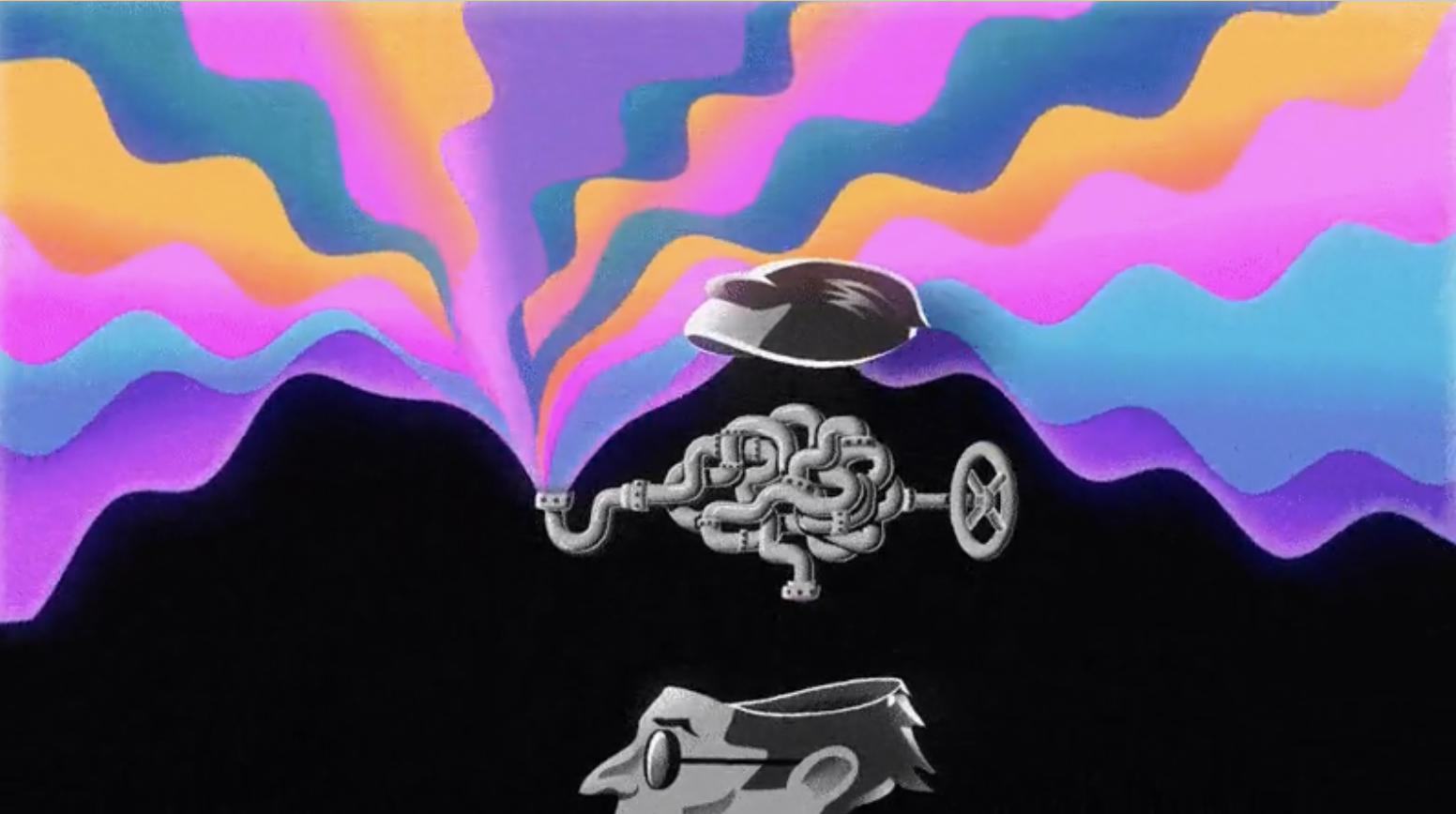
Unraveling the Dream’s animation for Huxley’s experience of ordinary perception beginning to dismantle.
Aldous Huxley (1894–1963) was an English writer and philosopher renowned for his incisive novels, essays, and social commentary. A leading intellectual of the 20th century, he explored the intersections of science, technology, and human values, leaving a lasting mark on modern literature and thought. In this book, The Doors of Perception, he chronicled his experiments with mescaline, examining altered states of consciousness and the nature of perception—a text that later inspired countercultural thinkers and musicians.
The Unraveling the Dream video explained that Aldous Huxley proposed that:
The brain and nervous system act as a “reducing valve” on a much larger field of consciousness he called “Mind at Large.”
What does that mean?
Instead of:
Consciousness being produced by the brain
Huxley suggests:
Consciousness already exists in a vast, unrestricted form
The brain narrows it down so we can function
🧩 Why a “Reducing Valve”?
Because without filtering, reality would be overwhelming.
Imagine perceiving:
Every possible detail
Every association
Every sensory input
Every memory at once
You wouldn’t be able to:
Focus
Act
Survive
So the brain:
Blocks most of it out
Lets in only what’s useful
Consciousness becomes a manageable slice of a much larger reality.
🌌 What Is “Mind at Large”?
Huxley used this term to describe:
A vast field of potential experience
Not limited to individual brains
Possibly fundamental to reality itself
It’s not a scientific term in the strict sense—it’s more philosophical.
But the idea is:
Your everyday awareness is just a tiny selection from a much bigger field.
💊 Where Psychedelics Come In
The video likely connects this idea to psychedelics (as Huxley did in The Doors of Perception).
His claim:
Psychedelics weaken the reducing valve.
So instead of filtering tightly:
More information flows in
Perception becomes richer, less constrained
This can lead to:
Intense sensory detail
Novel associations
A sense of unity or “expanded consciousness”
🧠 How This Maps to Modern Neuroscience
Huxley didn’t have brain imaging—but his idea lines up surprisingly well with newer theories:
Predictive processing → the brain filters reality through models
REBUS theory → psychedelics relax rigid predictions
Entropic brain → increased flexibility of brain activity
In modern terms, you could translate Huxley like this:
The brain normally constrains perception, and psychedelics temporarily loosen those constraints.
⚖️ Important Clarification
Huxley’s idea is not proven scientific fact.
It’s a philosophical model.
Two competing views:
Standard Neuroscience
Brain generates consciousness
Huxley’s View
Brain filters a larger consciousness
The video presents Huxley’s idea as:
A compelling alternative way to think about consciousness—not a settled conclusion.
🎯 Final Take on Huxley
Huxley’s “reducing valve” theory reframes everything:
You’re not seeing less because the world is small
You’re seeing less because your brain has to limit what gets through
And psychedelics?
They may not add anything new—
they may simply remove some of the filters.
To see how these ideas map to current psychedelic research compare these three Models of Consciousness (Same Problem, Different Answers)
1. Aldous Huxley: The Brain Filters Reality
Huxley’s claim:
Consciousness is vast (“Mind at Large”), and the brain reduces it to a usable stream.
Normal state → heavy filtering
Psychedelics → filter weakens
Result → expanded perception
👉 Core idea:
You’re seeing less than what’s really there
2. Anil Seth: The Brain Predicts Reality
Seth flips the direction:
The brain generates perception through prediction, constrained by sensory input.
Perception = “controlled hallucination”
The brain guesses what’s out there
Sensory input corrects those guesses
👉 Core idea:
You’re not seeing reality—you’re seeing your brain’s best model of it
3. Robin Carhart-Harris: Psychedelics Relax Beliefs
REBUS (Relaxed Beliefs Under Psychedelics):
Psychedelics reduce the influence of top-down predictions (priors).
Normal state → strong beliefs constrain perception
Psychedelics → those beliefs loosen
Result → more bottom-up information flows in
👉 Core idea:
Your mental model becomes less rigid, more flexible
🔗 How They Actually Fit Together
At first glance, Huxley and Seth seem opposed:
Huxley → brain filters a larger reality
Seth → brain constructs reality
But here’s the key insight:
Both describe constraint.
🧩 Unified Interpretation
We can translate Huxley into modern language:
HuxleyModern Neuroscience TranslationReducing valvePredictive filteringMind at LargeHigh-dimensional sensory + internal dataPsychedelics open the valvePsychedelics relax priors
So instead of:
“Opening to cosmic consciousness” (Huxley literally)
We get:
Reducing constraints on perception and cognition
🧠 What Psychedelics Actually Do (Modern View)
Research shows psychedelics:
Decrease activity in the default mode network (DMN)
Increase global brain connectivity
Increase signal diversity (entropy)
👉 Functionally, this means:
Less top-down control
More bottom-up influence
More cross-talk between brain regions
🔥 This Is the Crucial Bridge
Here’s the clean synthesis:
Huxley was right about the effect, but modern science reframes the mechanism.
Huxley:
→ The brain removes filters, revealing more realitySeth / Carhart-Harris:
→ The brain relaxes predictive constraints, allowing more possibilities of interpretation
⚖️ Where They Still Disagree
There is still one unresolved tension:
Huxley implies:
There is a real, larger consciousness being revealed
Modern neuroscience says:
There is no evidence for that
Only that:
The brain becomes less constrained and more generative
🎯 The Deep Insight
All three models converge on this:
Your normal experience of reality is highly constrained.
Stable
Predictable
Narrow
And altered states (psychedelics, meditation, etc.):
Loosen those constraints
Leading to:
Novel perception
Insight
Ego dissolution
🧠 Final Synthesis
You can summarize everything like this:
Huxley:
→ The brain filters reality downSeth:
→ The brain builds reality upCarhart-Harris:
→ Psychedelics loosen the rules governing that process
🧩 The Cleanest Modern Translation of Huxley
The “reducing valve” is not filtering a cosmic consciousness—it’s constraining a predictive model of the world and self.
And psychedelics?
They temporarily relax that constraint, allowing the mind to explore a wider range of possible experiences.